AI Appraisal Estimate

AI-generated estimates · not official valuations

From the user

What was submitted

Photo and notes provided by the user — not generated by AI

Submitted item photo
Submitted photo · June 13, 2026

User's notes

No additional notes provided.

AI analysis below

AI appraisal

AI analysis & estimate

AI-Generated · Verify before acting

Everything below is generated by AI for informational purposes only. AI can make mistakes — the AI may misidentify items or misattribute them (artist, maker, brand, designer, origin, era). This is not an official valuation and should not be used for insurance, sale, tax, estate, legal, or lending purposes — or any decision requiring a certified appraisal. It is not an authoritative claim about any person, brand, or rights holder — do not share or rely on it as a factual statement about a third party. Always consult qualified professionals before making financial decisions.

Read the full disclaimer

AI Identification

·Not independently authenticated·Verify before acting

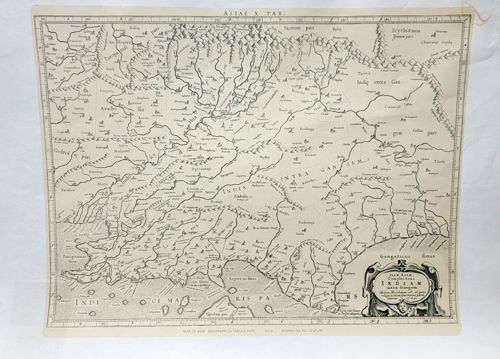
Ptolemaic Map of India Intra Gangem (Asia Table X)

Antiquarian Maps and Cartography

AI Estimated Value

·Not an official valuation·Verify before acting

$1,200 - $1,800 USD

As of June 13, 2026

AI Item Analysis

·AI can make mistakes·Verify before acting
This item is an antique black-and-white woodcut or copperplate engraved map titled 'ASIAE X TAB' centered on India and Southeast Asia. The map is based on Claudius Ptolemy's Geographia and likely dates from the 16th to early 17th century. It features a detailed cartographic representation of 'INDIA INTRA GANGEM' (India within the Ganges), showing rivers, mountain ranges depicted as stylized molehills, and numerous ancient settlements. The geography reflects the transitional Renaissance understanding of the region, where classical Greek knowledge met early Age of Discovery exploration. The margins include a graduated scale for latitude and longitude. A notable decorative feature is the elaborate Baroque-style cartouche in the lower right corner, which contains the latin title text and is flanked by ornamental scrollwork and a cherub face. Physically, the map is printed on aged, off-white laid paper. It shows signs of historic wear, including slight yellowing, foxing, and visible vertical creasing, particularly along the centerfold which suggests it was originally bound in an atlas. Small tears or chips are visible at the upper-right edge. The print quality is high, showing fine linework in the topography and lettering, characteristic of early European printing craftsmanship.
AI Appraisal Report

·AI can make mistakes·Verify before acting
I have virtually examined this 'Tabula Asiae X' based on the provided imagery. The map is a significant representative of 16th-century Ptolemaic cartography, likely originating from a Latin edition of Geographia (possibly Magini or Gastaldi/Ruscelli). The use of 'India Intra Gangem' terminology and the distinctive tapered shape of the sub-continent reflect the classic Renaissance transition from ancient cosmography to early modern observation. The copperplate engraving exhibits high-quality line work and a balanced Baroque cartouche, which are highly desirable to collectors of early Asian maps. Regarding condition, it shows age-typical foxing and a prominent centerfold crease which is standard for atlas-bound sheets. The small chips and minor oxidation don't significantly detract from the ocular appeal but do temper the valuation compared to pristine examples. The market for Ptolemaic maps remains robust, with India serving as a blue-chip region for South Asian and European collectors. This piece sits in a midrange category: it is more valuable than later 18th-century miniatures but less than the ultra-rare 15th-century incunabula or hand-colored editions by Ortelius. Limitations: Without physical inspection, I cannot verify the presence of a watermark (crucial for dating the paper stock), the exact depth of the plate mark, or whether the paper's acidity has compromised its structural integrity. Authentication via image alone is preliminary. A full professional appraisal would require examining the paper texture under raking light, verifying provenance, and performing a chemical analysis of the ink to ensure it is a contemporary strike rather than a later 19th-century facsimile.

Get your items appraised

Instant estimates of your treasures with AI-powered appraisals

Browse More Appraisals