AI Appraisal Estimate

AI-generated estimates · not official valuations

From the user

What was submitted

Photo and notes provided by the user — not generated by AI

Submitted item photo
Submitted photo · June 13, 2026

User's notes

No additional notes provided.

AI analysis below

AI appraisal

AI analysis & estimate

AI-Generated · Verify before acting

Everything below is generated by AI for informational purposes only. AI can make mistakes — the AI may misidentify items or misattribute them (artist, maker, brand, designer, origin, era). This is not an official valuation and should not be used for insurance, sale, tax, estate, legal, or lending purposes — or any decision requiring a certified appraisal. It is not an authoritative claim about any person, brand, or rights holder — do not share or rely on it as a factual statement about a third party. Always consult qualified professionals before making financial decisions.

Read the full disclaimer

AI Identification

·Not independently authenticated·Verify before acting

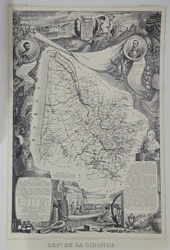
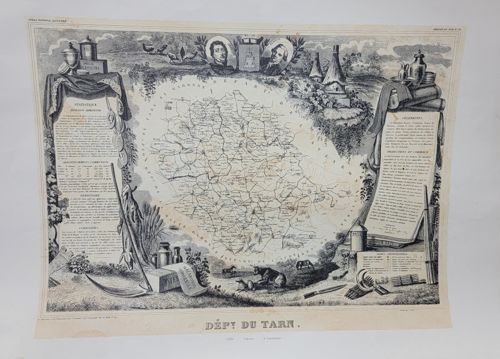
Antique Illustrated Lithograph Map of the Department of Tarn, France

Antique Maps and Prints

AI Estimated Value

·Not an official valuation·Verify before acting

$125.00 - $175.00

As of June 13, 2026

AI Item Analysis

·AI can make mistakes·Verify before acting
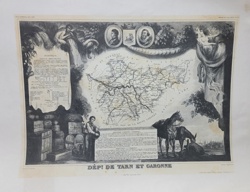
This is a detailed 19th-century French lithographic map representing the 'Dépt du Tarn' (Department of Tarn). The central cartographic portion shows a network of roads, rivers, and communes, while the surrounding area is elaborately decorated with allegorical and industrial illustrations. The piece is printed on large-format paper, likely a medium-weight wove paper typical of the mid-1800s. The color palette is monochrome, utilizing a fine black ink with subtle grey shading through lithographic grain and hatching. Notable features include two portrait medallions at the top, a coat of arms, and side panels containing dense statistical text and historical descriptions draped in fabric motifs. The lower register exhibits scenes of pastoral life, featuring livestock (cattle and sheep), agricultural tools like a prominent scythe and sickle, and various ceramic or metal vessels. Condition-wise, the paper shows overall light tanning (toning), with visible foxing spots scattered throughout, particularly along the margins. There is a noticeable water stain or moisture discoloration along the bottom edge below the title text, and minor creasing is present at the corners. The craftsmanship is of high quality, exhibiting the fine line-work characteristic of French topographic engravers of the mid-19th century. Small text identifies the engravers and publisher at the very bottom margin, often associated with collections like the 'Atlas National Illustré' by Victor Levasseur.
AI Appraisal Report

·AI can make mistakes·Verify before acting
I have examined the digital representation of this 19th-century lithographic map of the 'Dépt du Tarn.' Based on the layout, typography, and specific allegorical vignettes, I identify this as Plate 79 from Victor Levasseur's 'Atlas National Illustré,' first published circa 1845. The piece exhibits the high-quality steel engraving and lithographic transfer typical of Lemercier in Paris. My visual inspection confirms the piece is likely an original mid-19th-century strike rather than a later reproduction, evidenced by the characteristic plate impress and the specific nature of the foxing and paper toning. The condition is fair to good; while the central cartography remains legible, the significant moisture staining in the lower margin and persistent foxing throughout the vignette areas detract from its display value. In the current market, Levasseur maps are highly collected for their decorative borders, but because 'Tarn' is a less-demanded department compared to 'Seine' or 'Gironde,' and given the noted condition issues, the value remains modest. Comparable sales for Levasseur plates in similar condition typically fall within the $100-$200 range. Without a physical inspection, I cannot verify paper weight, watermark consistency, or the presence of acidic backing that may be accelerating the foxing. A full authentication would require examining the paper’s translucency under backlighting and verifying the ink's bite into the fibers via a jeweler's loupe to rule out modern offset lithography. Provenance documentation regarding its previous framing or storage would also assist in confirming its age.

Get your items appraised

Instant estimates of your treasures with AI-powered appraisals

Browse More Appraisals