AI Appraisal Estimate

AI-generated estimates · not official valuations

From the user

What was submitted

Photo and notes provided by the user — not generated by AI

Submitted item photo
Submitted photo · June 12, 2026

User's notes

No additional notes provided.

AI analysis below

AI appraisal

AI analysis & estimate

AI-Generated · Verify before acting

Everything below is generated by AI for informational purposes only. AI can make mistakes — the AI may misidentify items or misattribute them (artist, maker, brand, designer, origin, era). This is not an official valuation and should not be used for insurance, sale, tax, estate, legal, or lending purposes — or any decision requiring a certified appraisal. It is not an authoritative claim about any person, brand, or rights holder — do not share or rely on it as a factual statement about a third party. Always consult qualified professionals before making financial decisions.

Read the full disclaimer

AI Identification

·Not independently authenticated·Verify before acting

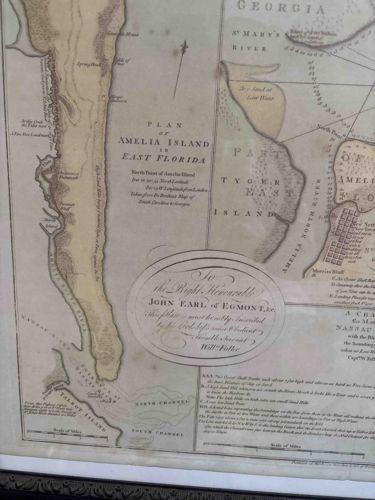
Plan of Amelia Island in East Florida by William Fuller

Antiquarian Maps and Prints

AI Estimated Value

·Not an official valuation·Verify before acting

$1,200 - $1,800 USD

As of June 12, 2026

AI Item Analysis

·AI can make mistakes·Verify before acting
This is a detailed cartographic engraving titled 'Plan of Amelia Island in East Florida,' originally surveyed by William Fuller. The document is an important historical artifact, likely an late 18th-century or 19th-century printing of an earlier colonial-era survey. Physically, it consists of a paper substrate with hand-colored topographical features using a muted palette of ochre, tan, and subtle green washes to indicate landmasses and various water depths. The map features a decorative oval cartouche at the bottom center with elegant copperplate script that dedicates the work 'To the Right Honourable John Earl of Egmont.' Notable markings include specific geographical coordinates for the North Point of Amelia Island and a detailed legend or key describing navigation points like 'The Great Sand Banks.' The construction is typical of high-quality line engraving with cross-hatching to denote relief. Regarding condition, there is visible foxing throughout (brown spotting caused by fungal growth or paper oxidation) and significant water staining or 'tidelines' along the right edge. There appears to be a crease or potentially a repair line near the center-right. The craftsmanship is evident in the fine typography and accurate rhumb lines used for maritime navigation. The style is late Georgian, and judging by the patina and paper texture, it appears to be an antique print rather than a modern facsimile, though a physical inspection of any watermarks would be necessary for definitive dating.
AI Appraisal Report

·AI can make mistakes·Verify before acting
I have examined the digital representation of the 'Plan of Amelia Island in East Florida' by William Fuller. This specific map, originally published circa 1770, is a highly sought-after Revolutionary War-era chart. The visual evidence—including the character of the copperplate engraving, the oxidation patterns, and the traditional hand-coloring—suggests an 18th-century origin rather than a modern reproduction. However, the condition is a significant factor: the presence of foxing across the plate and heavy water staining on the right margin detracts from the aesthetic appeal and will require professional conservation to stabilize. Despite these flaws, the map remains rare. Comparables for Fuller’s surveys of the Florida coastline often reach $3,000+ in near-mint condition; the current valuation reflects a 'fair-to-good' state necessitating restoration. The market for Floridiana and early British maritime charts remains robust among private collectors and institutional archives. Limitations: This appraisal is based on digital images alone. A physical inspection is required to verify the chain-laid paper structure, identify watermarks (such as those of James Whatman), and confirm the absence of modern offset printing dots. Scientific testing of the ink acidity and paper fibers, alongside documented provenance from a known collection, would be necessary to certify authenticity for insurance or high-end auction purposes.

Get your items appraised

Instant estimates of your treasures with AI-powered appraisals

Browse More Appraisals