AI Appraisal Estimate

AI-generated estimates · not official valuations

From the user

What was submitted

Photo and notes provided by the user — not generated by AI

Submitted item photo
Submitted photo · June 13, 2026

User's notes

No additional notes provided.

AI analysis below

AI appraisal

AI analysis & estimate

AI-Generated · Verify before acting

Everything below is generated by AI for informational purposes only. AI can make mistakes — the AI may misidentify items or misattribute them (artist, maker, brand, designer, origin, era). This is not an official valuation and should not be used for insurance, sale, tax, estate, legal, or lending purposes — or any decision requiring a certified appraisal. It is not an authoritative claim about any person, brand, or rights holder — do not share or rely on it as a factual statement about a third party. Always consult qualified professionals before making financial decisions.

Read the full disclaimer

AI Identification

·Not independently authenticated·Verify before acting

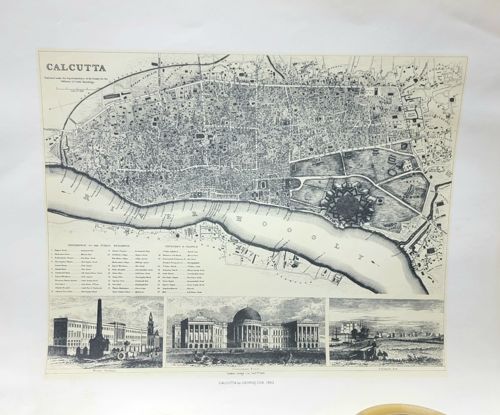
Antiquarian Map of Calcutta and the Hoogly River

Antique Map Reproductions / Cartography

AI Estimated Value

·Not an official valuation·Verify before acting

$45.00 - $75.00

As of June 13, 2026

AI Item Analysis

·AI can make mistakes·Verify before acting
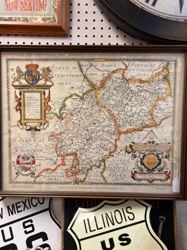
This item is a detailed monochromatic print of an antiquarian map depicting Calcutta (now Kolkata), India, and the adjacent River Hoogly. The map is printed on a rectangular cream-colored paper stock with black ink. The upper portion features a high-density topographical plan of the city, showing street layouts, various plots of land, and a prominent star-fort design representing Fort William. Below the map, there is a comprehensive 'References to the Public Buildings' index organized into columns, as well as several topographical vignettes along the bottom edge showing architectural landmarks such as 'The Government House' and waterfront scenes. The text is crisp and reflects 19th-century typography. The print appears to be a modern or mid-20th-century reproduction of an 1842 original, indicated by the small caption 'CALCUTTA IN 1842' centered at the very bottom margin. Physically, the paper shows minor toning consistent with age but lacks significant foxing, heavy creasing, or tearing, suggesting it has been well-preserved or is of more recent manufacture. The linework is fine, indicative of lithographic or high-quality offset printing techniques designed to emulate historical steel engravings. The composition is balanced, combining cartographic precision with artistic illustrations of colonial-era architecture.
AI Appraisal Report

·AI can make mistakes·Verify before acting
I have conducted a visual examination of the print depicting 'Calcutta in 1842.' Based on the crispness of the linework, the uniformity of the cream-toned paper stock, and the explicit 20th-century captioning at the bottom margin, I have identified this item as a modern decorative reproduction rather than an original 1842 lithograph. The condition appears to be very good, with minimal toning and no evidence of the acidic foxing or structural brittle-edge wear typically associated with 19th-century organic paper. Market demand for such reproductions is steady but limited to the decorative and 'souvenir' segments. Unlike original colonial-era cartographic works by firms such as Thacker, Spink & Co., which can command thousands of dollars, these mid-to-late 20th-century offsets are produced in high volume for framing. They serve as excellent historical references but lack the scarcity or 'plate-mark' physical characteristics of antique engravings. Comparables for similar Indian topographical reproductions usually sell within the $40 to $80 range at retail galleries or specialized decor auctions. It is important to note that this appraisal is based solely on digital images. A definitive assessment of age requires an in-person examination to check for watermarks, mechanical wood-pulp vs. cotton-rag fiber composition, and the presence of dot patterns under magnification (suggesting modern offset printing). To elevate this to a fine-art valuation, provenance documenting the print's purchase history or an analysis of the ink's chemical composition would be required. In its current state, it remains a handsome, high-quality decorative piece with historical utility but negligible investment value.

Get your items appraised

Instant estimates of your treasures with AI-powered appraisals

Browse More Appraisals