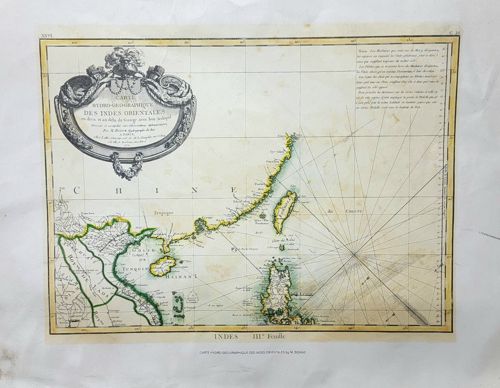
CARTE HYDRO-GEOGRAPHIQUE DES INDES ORIENTALES by Rigobert Bonne
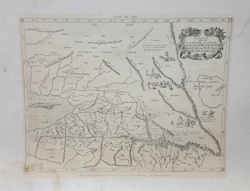
This is a hand-colored antique engraved map titled 'CARTE HYDRO-GEOGRAPHIQUE DES INDES ORIENTALES', focused on the coasts of China, Taiwan (Formose), and Southeast Asia. The map is an authentic copperplate engraving, likely dating to the late 18th century, circa 1770-1780, authored by Rigobert Bonne, the Royal Hydrographer to the French King. The piece features a prominent Baroque-style title cartouche in the upper left corner, adorned with ornate scrollwork and garlands. The coastline is highlighted with greenish-yellow professional hand-coloring. Notable geographical features include 'CHINE', 'Isle Formose', and the 'Golfe de la Sonde'. Rhumb lines emanate from a central point, emphasizing its utility as a nautical or hydrographic chart. The paper shows signs of age-related toning, minor foxing (brown spotting), and some faint creasing. The print is contained within a simple double-line border with latitude and longitude markings. A block of French text occupies the upper right quadrant, detailing maritime notes. The overall craftsmanship reflects the high standards of French cartography during the Enlightenment, displaying fine line work and clear typography.
AI-Generated Appraisal Disclaimer
Estimated Value
$450 - $650
Basic Information
Category
Antique Maps and Cartography
Appraised On
March 15, 2026
Estimated Value
$450 - $650
Item Description
This is a hand-colored antique engraved map titled 'CARTE HYDRO-GEOGRAPHIQUE DES INDES ORIENTALES', focused on the coasts of China, Taiwan (Formose), and Southeast Asia. The map is an authentic copperplate engraving, likely dating to the late 18th century, circa 1770-1780, authored by Rigobert Bonne, the Royal Hydrographer to the French King. The piece features a prominent Baroque-style title cartouche in the upper left corner, adorned with ornate scrollwork and garlands. The coastline is highlighted with greenish-yellow professional hand-coloring. Notable geographical features include 'CHINE', 'Isle Formose', and the 'Golfe de la Sonde'. Rhumb lines emanate from a central point, emphasizing its utility as a nautical or hydrographic chart. The paper shows signs of age-related toning, minor foxing (brown spotting), and some faint creasing. The print is contained within a simple double-line border with latitude and longitude markings. A block of French text occupies the upper right quadrant, detailing maritime notes. The overall craftsmanship reflects the high standards of French cartography during the Enlightenment, displaying fine line work and clear typography.
Related Tags
Get Your Items Appraised
Instant estimates of your treasures with AI-powered instant appraisals