AI Appraisal Estimate

AI-generated estimates · not official valuations

From the user

What was submitted

Photo and notes provided by the user — not generated by AI

Submitted item photo
Submitted photo · May 18, 2026

User's notes

Rc gorman

AI analysis below

AI appraisal

AI analysis & estimate

AI-Generated · Verify before acting

Everything below is generated by AI for informational purposes only. AI can make mistakes — the AI may misidentify items or misattribute them (artist, maker, brand, designer, origin, era). This is not an official valuation and should not be used for insurance, sale, tax, estate, legal, or lending purposes — or any decision requiring a certified appraisal. It is not an authoritative claim about any person, brand, or rights holder — do not share or rely on it as a factual statement about a third party. Always consult qualified professionals before making financial decisions.

Note

This analysis also relies on unverified notes provided by the user, which may be incomplete or inaccurate and could affect the result.

Read the full disclaimer

AI Identification

·Not independently authenticated·Verify before acting

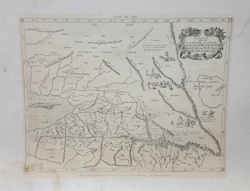
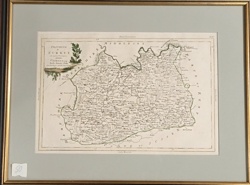
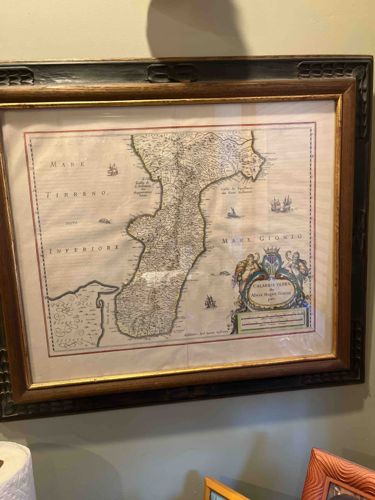
Framed 17th Century Map of Calabria Ultra by Willem Blaeu

Antique Maps and Cartography

AI Estimated Value

·Not an official valuation·Verify before acting

$1,200 - $1,800

As of May 18, 2026

AI Item Analysis

·AI can make mistakes·Verify before acting
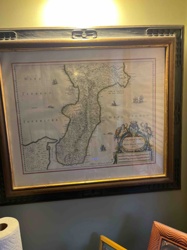
This item is a framed map titled 'Calabria Ultra' (the southern part of Modern Calabria, Italy), originally produced by the renowned Dutch cartographer Willem Janzsoon Blaeu circa 1635-1650. The piece demonstrates the high-quality copperplate engraving characteristic of the Golden Age of Dutch cartography. The map features the 'Mare Tirreno Inferiore' to the west and the 'Mare Jonio' to the east, populated with delicate illustrations of sailing vessels and sea monsters. A prominent, hand-colored decorative cartouche in the lower right corner displays traditional heraldic supporters and floral motifs. The map appears to be printed on laid paper, showing original fold lines consistent with historical atlas binding. It is housed in an ornate, deep-profile wood frame featuring a dark, perhaps ebonized, outer edge with relief carving and a gilded inner fillet. The paper shows a warm, aged patina with light foxing and visible undulations, suggesting it is not laid flat, which is common for authentic antique specimens. The black and gold frame appears to be a 20th-century addition, designed to complement the Baroque aesthetic of the original work. Note: While 'RC Gorman' was provided in the context, this item is a classical European map and does not depict Gorman's signature Navajo aesthetic.
AI Appraisal Report

·AI can make mistakes·Verify before acting
I have virtually examined this framed map of 'Calabria Ultra' attributed to Willem Janzsoon Blaeu (c. 1635-1650). This specimen exemplifies the 'Golden Age' of Dutch cartography, featuring the characteristic copperplate precision, elaborate decorative cartouche, and maritime vignettes that define Blaeu’s workshop. The use of hand-coloring appears consistent with period styles, highlighting the provincial borders and the heraldic elements within the cartouche. Condition-wise, the map displays a warm patina and minor foxing consistent with three centuries of aging. The visible undulations and centered vertical fold line suggest the map was likely removed from a 'Theatrum Orbis Terrarum' atlas. While the 20th-century frame is of high quality and complements the Baroque aesthetic, value is primarily driven by the paper itself. Historically, Blaeu maps of Italian provinces are highly sought after by collectors of Mediterranean history, maintaining steady demand despite fluctuations in the broader decorative arts market. Comparables for individual Blaeu plates of Southern Italy typically hammer between $900 and $1,500 at specialist auctions, with premium framing adding to the retail valuation. Factors impacting value include the vibrancy of the hand-coloring and the lack of significant tears or 'acid burn.' Limitations: This appraisal is based on photographic evidence. Without physical inspection, I cannot confirm the presence of a watermark (such as the 'Cross of Lorraine' or 'P' mark) or examine the reverse for contemporary annotations. Full authentication would require removing the map from the frame to inspect the paper fibers and ink depth. For insurance purposes, I recommend a physical examination to rule out 19th-century lithographic reproductions or high-quality facsimiles.

Get your items appraised

Instant estimates of your treasures with AI-powered appraisals

Browse More Appraisals