AI estimate as of August 9, 2025 · verify with a professional before acting
AI-Generated · Verify before acting
Everything on this page is generated by AI for informational purposes only. AI can make mistakes — the AI may misidentify items or misattribute them (artist, maker, brand, designer, origin, era). This is not an official valuation and should not be used for insurance, sale, tax, estate, legal, or lending purposes — or any decision requiring a certified appraisal. It is not an authoritative claim about any person, brand, or rights holder — do not share or rely on it as a factual statement about a third party. Always consult qualified professionals before making financial decisions.
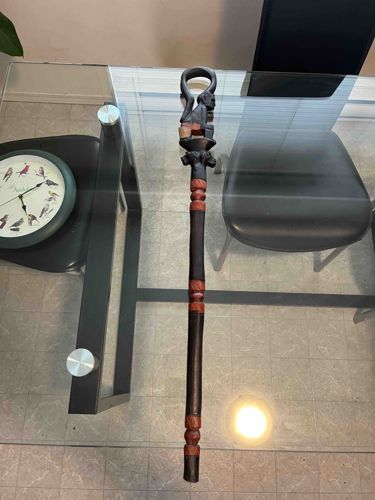
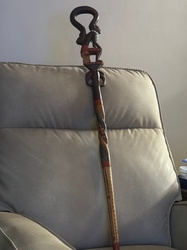
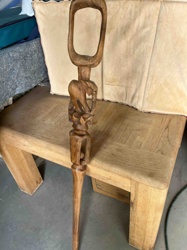
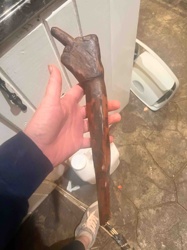
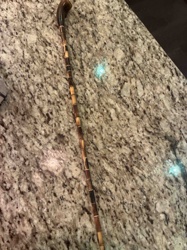
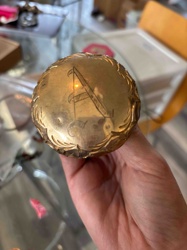
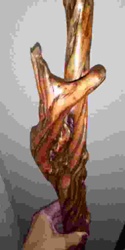
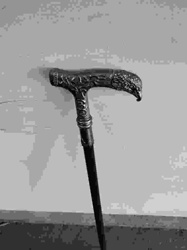
This item is a decorative wooden walking stick, likely of African origin, characterized by intricate carvings along its shaft and a prominent figural finial. The stick appears to be hand-carved from a dark hardwood, possibly ebony or a similarly dark-toned wood, with contrasting lighter wood elements integrated into the design. Its overall length seems to be approximately 3 to 4 feet, indicating it is a functional or ceremonial walking aid. The handle forms a distinctive closed loop, below which is a detailed carving of what appears to be a human or anthropomorphic figure, seated or depicted in a specific posture. Below this figure, there are additional carved elements, including what might be stylized faces or animal heads, and geometric patterns. Further down the shaft, several sections are adorned with raised, carved bands of lighter-colored wood, possibly contrasting wood inserts or areas where the darker stain has been removed to reveal the natural wood tone. These bands are regularly spaced and add visual rhythm to the piece. The craftsmanship suggests a folk art or ethnographic piece, likely made for cultural significance, display, or limited practical use rather than heavy-duty support. There are no visible major cracks or breaks, but the surface exhibits a natural patina consistent with age and handling, indicating some wear and minor abrasions are likely present upon closer inspection. The absence of modern manufacturing marks suggests it is either a traditional handicraft or an older piece. Its aesthetic indicates a possible mid to late 20th-century creation, although older examples are possible.
AI Appraisal Report
Upon my virtual examination of the African Figural Carved Walking Stick, I assess its condition as good, retaining a pleasing patina consistent with age and handling. There are no obvious signs of major structural damage, such as cracks or breaks, which is a positive indicator. The contrasting wood elements and intricate figural carving suggest a traditional handicraft. Authenticity, based solely on imagery, appears strong for a mid-to-late 20th-century piece from an ethnographic or folk art context.
In terms of market conditions, similar African carved walking sticks or ceremonial staffs, particularly those with detailed figural work, command moderate interest. Comparables typically range based on the complexity of carving, specific cultural attribution (if known), and material quality. While not extremely rare, well-executed examples are sought after by collectors of African art and tribal artifacts. The multi-figured carving and contrasting wood demonstrate a higher level of craftsmanship than simpler pieces, enhancing its demand.
Factors significantly impacting its value include its excellent visual condition, the thematic complexity of the carvings (suggesting potential ritualistic or symbolic meaning), and its aesthetic appeal. However, a limitation of this remote appraisal is the inability to verify the wood species definitively, assess the integrity of the lighter wood inlays, or detect subtler repairs not visible in the images.
For full authentication and a more precise valuation, an in-person examination is crucial. This would allow for a tactile assessment of the surface wear, confirmation of wood types through grain analysis, and detection of any restorations. Provenance documentation, detailing its acquisition history and cultural origin, would also significantly enhance its value and confirm authenticity.