AI Appraisal Estimate

AI-generated estimates · not official valuations

From the user

What was submitted

Photo and notes provided by the user — not generated by AI

Submitted item photo
Submitted photo · May 27, 2026

User's notes

Identification number on the back

AI analysis below

AI appraisal

AI analysis & estimate

AI-Generated · Verify before acting

Everything below is generated by AI for informational purposes only. AI can make mistakes — the AI may misidentify items or misattribute them (artist, maker, brand, designer, origin, era). This is not an official valuation and should not be used for insurance, sale, tax, estate, legal, or lending purposes — or any decision requiring a certified appraisal. It is not an authoritative claim about any person, brand, or rights holder — do not share or rely on it as a factual statement about a third party. Always consult qualified professionals before making financial decisions.

Note

This analysis also relies on unverified notes provided by the user, which may be incomplete or inaccurate and could affect the result.

Read the full disclaimer

AI Identification

·Not independently authenticated·Verify before acting

Engraved Monogrammed Cane/Walking Stick Pommel

Decorative Object / Personal Accessory Component

AI Estimated Value

·Not an official valuation·Verify before acting

$75-125

As of May 27, 2026

AI Item Analysis

·AI can make mistakes·Verify before acting
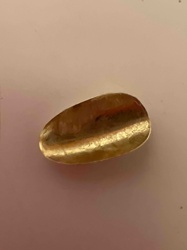
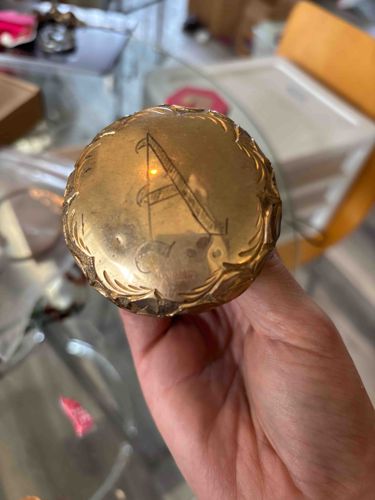
The item appears to be the ornamental top or pommel of a cane or walking stick, possibly a standalone finial. It is circular and highly polished with a golden hue, suggesting it is made of brass, bronze, or a gold-plated metal. The top surface features a prominently engraved initial "A" in a stylized, somewhat blocky script with decorative serifs. The engraving shows some signs of wear and slight discoloration within the etched lines. Surrounding the central initial, the outer edge of the circular top is elaborately decorated with a debossed or carved floral or foliate motif, giving it a scalloped, almost ruffled appearance. This border design suggests a classical or Art Nouveau influence, given its organic, flowing lines. The surface of the item exhibits numerous minor scratches, scuffs, and possibly some small dents consistent with age and regular handling, as well as a visible patina in recessed areas, indicating its vintage or antique status. The reflective qualities of the metal suggest it was once very shiny, and while it retains some luster, there are areas of dullness and minor tarnish. Its construction appears robust, suggesting it was designed to withstand significant use. The craftsmanship of the engraving and the decorative border is fine, indicating a degree of quality. While no specific maker's marks or signatures are visible in the provided image, the mention of an "identification number on the back" in the additional context is significant and would be crucial for further identification and appraisal. Based on the style and apparent wear, it likely dates from the late 19th to early 20th century.
AI Appraisal Report

·AI can make mistakes·Verify before acting
Upon examining the provided image, this item appears to be a high-quality, antique cane or walking stick pommel, likely dating to the late 19th or early 20th century. The style, characterized by the elaborate floral/foliate border and the stylized 'A' monogram, is consistent with aesthetics from the Art Nouveau or late Victorian eras. The material appears to be a gold-toned metal, possibly brass, bronze, or a gold-plated alloy, exhibiting a natural patina and surface wear consistent with its age and use. The craftsmanship of the engraving and decorative border is of a fine standard. The market for antique walking stick components is niche but active among collectors. The value is driven by material, craftsmanship, condition, and rarity. While the single initial 'A' monogram personalizes the item, it can also limit its appeal compared to a non-monogrammed or more universally desirable motif. The presence of an identification number is a significant factor, potentially allowing for attribution to a specific maker, which would substantially increase its value. However, without a physical examination to identify this mark and test the metal composition, a definitive appraisal is limited. Full authentication would require in-person inspection to verify the maker's mark, test the metal (e.g., acid or XRF testing), and assess the construction more thoroughly. Without identifying a prominent maker like Tiffany & Co. or Fabergé, its value remains as a well-crafted decorative antique.

Get your items appraised

Instant estimates of your treasures with AI-powered appraisals

Browse More Appraisals