AI Appraisal Estimate

AI-generated estimates · not official valuations

From the user

What was submitted

Photo and notes provided by the user — not generated by AI

Submitted item photo
Submitted photo · May 22, 2026

User's notes

No additional notes provided.

AI analysis below

AI appraisal

AI analysis & estimate

AI-Generated · Verify before acting

Everything below is generated by AI for informational purposes only. AI can make mistakes — the AI may misidentify items or misattribute them (artist, maker, brand, designer, origin, era). This is not an official valuation and should not be used for insurance, sale, tax, estate, legal, or lending purposes — or any decision requiring a certified appraisal. It is not an authoritative claim about any person, brand, or rights holder — do not share or rely on it as a factual statement about a third party. Always consult qualified professionals before making financial decisions.

Read the full disclaimer

AI Identification

·Not independently authenticated·Verify before acting

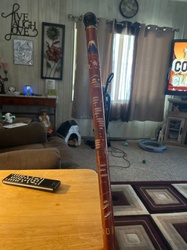
Hand-Carved Folk Art Twisted Walking Stick

Folk Art / Collectible Walking Sticks

AI Estimated Value

·Not an official valuation·Verify before acting

$175 - $250

As of May 22, 2026

AI Item Analysis

·AI can make mistakes·Verify before acting
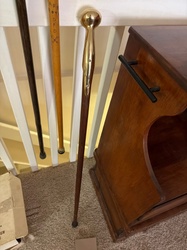
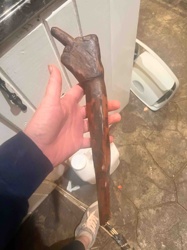
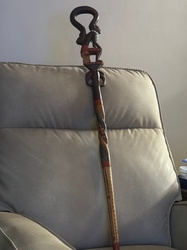
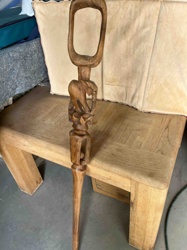
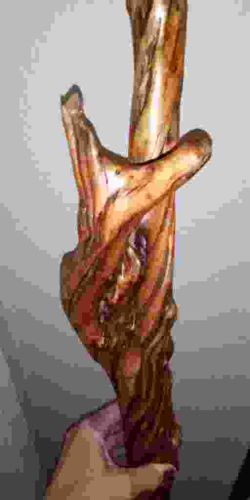
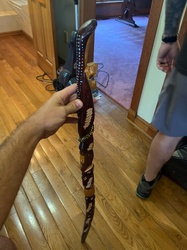
This unique piece is a hand-carved walking stick or decorative staff, likely fashioned from a naturally occurring vine-wrapped sapling such as honeysuckle or bittersweet, which gives the wood its distinctive spiral or 'corkscrew' shape. The item features a warm, honey-toned finish that highlights the intricate grain patterns and the deep undulations of the twisted wood. The upper portion of the staff displays an organic, wing-like protrusion or burl that has been smoothed and polished to serve as an ergonomic grip or aesthetic focal point. The surface appears to be coated in a high-gloss lacquer or polyurethane finish, which protects the wood while accentuating its natural amber and reddish hues. In terms of condition, the wood seems well-preserved with a healthy patina; however, there are minor surface abrasions and small dark pits consistent with natural wood blemishes or insects (now inactive). There are no visible maker's marks or signatures, suggesting this is a piece of vernacular folk art or a custom hobbyist creation, potentially dating from the late 20th century to the present. The craftsmanship is evident in the careful sanding of the sharp ridges and the preservation of the natural helical growth pattern, making it both a functional mobility aid and a sculptural work of art.
AI Appraisal Report

·AI can make mistakes·Verify before acting
I have examined the digital representations of this hand-carved folk art walking stick. The piece exhibits characteristic traits of a naturally 'strangled' sapling, where climbing vines create the distinctive helical growth pattern. The craftsmanship demonstrates high skill in the sanding and finishing phases, transitioning smoothly from the organic burl handle into the twisted shaft. The high-gloss finish suggests a contemporary or late 20th-century origin, likely intended for the decorative folk art market or as a high-end functional accessory. Condition is generally excellent; while small pits and abrasions are noted, these are consistent with the natural lifecycle of the wood and do not detract from the structural integrity. The market for vernacular folk art remains stable, with specific demand for 'nature-made' curiosities. Comparables for unsigned, contemporary vine-twisted sticks typically fall within the $150 to $300 range, depending on the complexity of the twist and the quality of the wood species. The lack of a maker’s mark limits the value to its aesthetic and functional merits rather than a specific artist's provenance. Limitations: This appraisal is based solely on visual inspection of images. Accurate identification of the wood species (e.g., Diamond Willow vs. Honeysuckle) and a definitive assessment of the finish type (lacquer vs. modern polyurethane) require physical handling. An in-person examination would also be necessary to rule out structural cracks hidden beneath the finish and to verify the density of the wood, which would determine its suitability as a true mobility aid versus a purely decorative staff.

Get your items appraised

Instant estimates of your treasures with AI-powered appraisals

Browse More Appraisals