AI Appraisal Estimate

AI-generated estimates · not official valuations

From the user

What was submitted

Photo and notes provided by the user — not generated by AI

Submitted item photo
Submitted photo · June 16, 2026

User's notes

No additional notes provided.

AI analysis below

AI appraisal

AI analysis & estimate

AI-Generated · Verify before acting

Everything below is generated by AI for informational purposes only. AI can make mistakes — the AI may misidentify items or misattribute them (artist, maker, brand, designer, origin, era). This is not an official valuation and should not be used for insurance, sale, tax, estate, legal, or lending purposes — or any decision requiring a certified appraisal. It is not an authoritative claim about any person, brand, or rights holder — do not share or rely on it as a factual statement about a third party. Always consult qualified professionals before making financial decisions.

Read the full disclaimer

AI Identification

·Not independently authenticated·Verify before acting

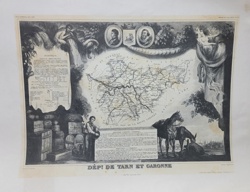
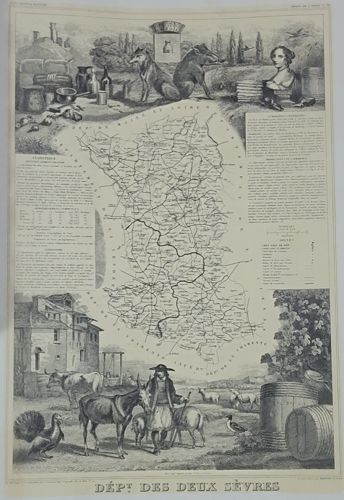
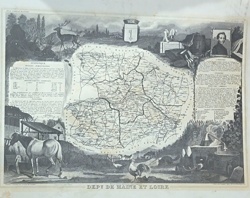
Antiquarian Map of the Département des Deux-Sèvres from Atlas National Illustré

Antique Maps and Prints

AI Estimated Value

·Not an official valuation·Verify before acting

$150-$250

As of June 16, 2026

AI Item Analysis

·AI can make mistakes·Verify before acting
This is a detailed mid-19th-century engraved map of the French department of Deux-Sèvres, likely originating from Victor Levasseur's 'Atlas National Illustré des 86 Départements et des Possessions de la France.' The piece is a black and white engraving on paper, featuring a central geographical map defined by its administrative boundaries and topography, surrounded by elaborate allegorical and descriptive vignettes. The top section showcases a wolf and a wild boar flanking a coat of arms, alongside still-life elements and a portrait bust. The bottom section depicts a pastoral scene with a farmer, livestock including cows, a donkey, and sheep, as well as wine barrels and local architecture. Extensive text panels flanking the map provide historical, statistical, and administrative data of the region. The engraving demonstrates high-level craftsmanship characteristic of 1840s-1850s French steel engraving, with fine line work and cross-hatching to create depth. Condition appears generally good with minor age-related toning (patina) and slight waviness in the paper, which is typical for antique prints of this period. There are visible margins, though the very bottom edge shows some slight cropping or wear near the title 'DÉPT DES DEUX SÈVRES'.
AI Appraisal Report

·AI can make mistakes·Verify before acting
I have conducted a visual examination of the mid-19th-century engraved map of the Département des Deux-Sèvres by Victor Levasseur. The piece exhibits the hallmark characteristics of the 'Atlas National Illustré' series, specifically the 1845-1852 editions. The steel engraving displays the high-contrast fine line work typical of the period, with the elaborate allegorical borders showcasing the region's agricultural and historical identity. The condition is assessed as 'Very Good' for its age; the visible toning and paper waviness are consistent with 19th-century wood-pulp or rag paper reacting to atmospheric moisture. The slight cropping at the bottom margin is a common result of historical framing but does affect the top-tier collectibility. The market for Levasseur maps remains stable; they are highly sought after by regional collectors and decorators due to their aesthetic 'vignette' style rather than purely for cartographical data. While individual department maps are not rare, Deux-Sèvres is moderately desirable. Because this specimen is uncolored (black and white), its value is slightly lower than hand-colored variants, though it retains better detail for study. This appraisal is based solely on high-resolution imagery. A definitive authentication would require an in-person inspection to verify the paper's watermark and the 'plate mark' indentation, which distinguishes an original period strike from a modern photolithographic reproduction. Scientific testing of the ink's oxidation and an examination of the verso (back) for repairs or mounting residue would be necessary for a final valuation.

Get your items appraised

Instant estimates of your treasures with AI-powered appraisals

Browse More Appraisals