AI Appraisal Estimate

AI-generated estimates · not official valuations

From the user

What was submitted

Photo and notes provided by the user — not generated by AI

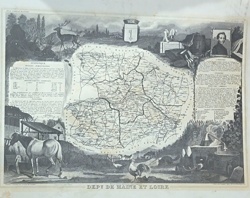
Submitted item photo
Submitted photo · June 16, 2026

User's notes

No additional notes provided.

AI analysis below

AI appraisal

AI analysis & estimate

AI-Generated · Verify before acting

Everything below is generated by AI for informational purposes only. AI can make mistakes — the AI may misidentify items or misattribute them (artist, maker, brand, designer, origin, era). This is not an official valuation and should not be used for insurance, sale, tax, estate, legal, or lending purposes — or any decision requiring a certified appraisal. It is not an authoritative claim about any person, brand, or rights holder — do not share or rely on it as a factual statement about a third party. Always consult qualified professionals before making financial decisions.

Read the full disclaimer

AI Identification

·Not independently authenticated·Verify before acting

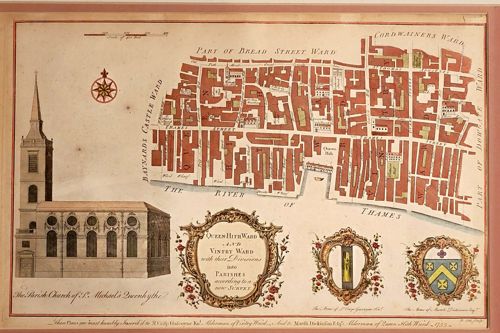
Queen-Hith Ward and Vintry Ward Map with St. Michael’s Queen-Hith Church

Antique Maps and Prints

AI Estimated Value

·Not an official valuation·Verify before acting

$450 - $650

As of June 16, 2026

AI Item Analysis

·AI can make mistakes·Verify before acting
This is a hand-colored engraved historical map and architectural print dating to 1755, titled 'Queen-Hith Ward and Vintry Ward with their Divisions into Parishes according to a new Survey.' The work is likely from John Stow’s ‘Survey of London,’ significantly updated by John Strype. The item features a detailed topographical plan of the Thames-side districts of London, including Queenhithe and Vintry, with street names like Thames Street and Bow Lane clearly visible. To the left is a large, detailed elevation of ‘The Parish Church of St. Michael’s Queen-Hith,’ showing its classical Wren-style architecture and prominent spire. The lower section includes three Rococo-style decorative cartouches: a central title cartouche flanked by the arms of Sir Crisp Gascoyne and Sir Martin Dickinson, to whom the plate is dedicated as noted in the bottom script. The paper shows significant yellowing consistent with mid-18th-century rag paper, with a visible vertical fold line in the center and some minor foxing and surface staining throughout. The engraving exhibits fine linework and high-quality craftsmanship characteristic of 18th-century cartography, with hand-applied watercolor washes in red, yellow, and green used to define blocks and heraldic elements.
AI Appraisal Report

·AI can make mistakes·Verify before acting
I have conducted a visual examination of the 1755 hand-colored engraving of Queen-Hith and Vintry Wards. This plate, likely originating from the 1754-55 edition of John Stow’s ‘Survey of London’ (updated by Strype), is a quintessential example of mid-18th-century English cartography. The inclusion of the elevation for St. Michael’s Queen-Hith and the heraldic dedications to Sir Crisp Gascoyne and Sir Martin Dickinson adds significant localized historical interest. The hand-coloring appears consistent with period application or high-quality later professional coloring, enhancing its decorative appeal. The condition shows typical aging, including a vertical publisher’s fold and noticeable foxing/toning, which is expected for mid-18th-century rag paper. While these imperfections are present, the plate remains intact with strong plate marks. In the current market, London ward maps of this period remain in steady demand among bibliophiles and interior designers, though values for Strype editions are generally more accessible than 17th-century counterparts. Comparables for Strype/Stow ward maps in similar condition typically range between $400 and $700 depending on the vibrance of the coloring. Limitations: My assessment is based solely on digital images. A physical inspection is required to verify the paper's watermark (which would confirm the 1750s manufacture), check for acidic backing or non-reversible adhesives, and ensure the hand-coloring isn't modern ‘restoration’ which can sometimes mask paper thinning. Full authentication would involve analyzing the chain of provenance and examining the paper fibers under magnification to confirm it is indeed handmade laid paper and not a high-quality facsimile reproduction.

Get your items appraised

Instant estimates of your treasures with AI-powered appraisals

Browse More Appraisals