AI Appraisal Estimate

AI-generated estimates · not official valuations

From the user

What was submitted

Photo and notes provided by the user — not generated by AI

Submitted item photo
Submitted photo · June 13, 2026

User's notes

No additional notes provided.

AI analysis below

AI appraisal

AI analysis & estimate

AI-Generated · Verify before acting

Everything below is generated by AI for informational purposes only. AI can make mistakes — the AI may misidentify items or misattribute them (artist, maker, brand, designer, origin, era). This is not an official valuation and should not be used for insurance, sale, tax, estate, legal, or lending purposes — or any decision requiring a certified appraisal. It is not an authoritative claim about any person, brand, or rights holder — do not share or rely on it as a factual statement about a third party. Always consult qualified professionals before making financial decisions.

Read the full disclaimer

AI Identification

·Not independently authenticated·Verify before acting

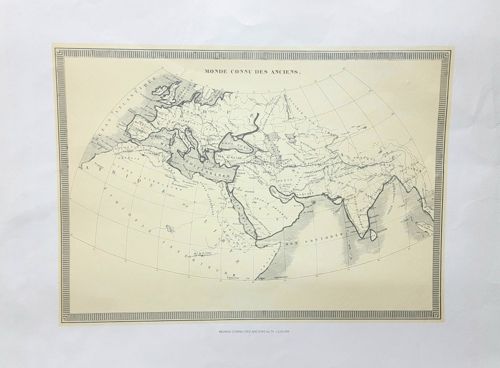
Monde Connu Des Anciens Map

Antique Maps and Ephemera

AI Estimated Value

·Not an official valuation·Verify before acting

$125 - $225

As of June 13, 2026

AI Item Analysis

·AI can make mistakes·Verify before acting
This item is an antique-style monochrome map entitled 'Monde Connu Des Anciens' (World Known to the Ancients), likely produced in France during the mid-to-late 19th century. The map is printed on cream-colored paper with a horizontal orientation, encased in a simple rectangular border featuring a classic fluted or 'piano key' pattern. It depicts a hemispherical projection of the Eastern Hemisphere as understood by ancient civilizations, covering Europe, North Africa, and parts of Asia including India and the Arabian Peninsula. The cartography utilizes fine line engraving, with shaded coastlines and topographical details indicating mountain ranges and major river systems. Text is in French, with notable labels such as 'OCEAN ATLANTIQUE' and 'MER DES INDES'. The paper shows significant signs of age-related wear, including prominent vertical and diagonal creasing, light foxing, and a natural yellowing or patina consistent with its estimated age. There is no visible evidence of modern chemical bleaching. The craftsmanship is indicative of high-quality lithography or steel-plate engraving from a historical atlas or educational text. Small text located at the bottom center likely credits the original engraver or publisher, further reinforcing its status as a 19th-century educational print.
AI Appraisal Report

·AI can make mistakes·Verify before acting
Based on my visual examination of the digital images provided, I have performed an appraisal of the 'Monde Connu Des Anciens' map. This piece appears to be a mid-19th-century steel-plate engraving, likely removed from a French historical atlas such as those produced by Victor Levasseur or similar cartographers of the era. The classical 'piano key' border and specific French nomenclature are consistent with educational prints from the 1840s to 1860s. The condition exhibits significant age-related characteristics. Specifically, I note prominent vertical and diagonal creasing, likely from original folding and subsequent improper storage. The foxing and 'golden' patina represent natural oxidation of the paper fibers. While these elements confirm age, the severity of the creases and visible foxing somewhat diminish the market value compared to a 'mint' specimen. In the current market for antique ephemera, French historical maps are consistently collected, though hemispherical 'ancient world' projections are more common than specific regional maps. Comparables at auction typically range between $100 and $300 depending on the notoriety of the engraver and state of preservation. Limitations: My assessment is based solely on digital images. I cannot definitively verify the paper's watermark, weight, or the presence of a 'plate mark' indentation which distinguishes a period strike from a high-quality later reproduction. For full authentication, an in-person examination is required to check for chemical wood-pulp content and to inspect the ink under magnification for characteristic 19th-century 'bleeding' patterns versus modern halftone dots. Provenance or an original atlas binding would further solidify this valuation.

Get your items appraised

Instant estimates of your treasures with AI-powered appraisals

Browse More Appraisals