AI estimate as of November 12, 2025 · verify with a professional before acting
AI-Generated · Verify before acting
Everything on this page is generated by AI for informational purposes only. AI can make mistakes — the AI may misidentify items or misattribute them (artist, maker, brand, designer, origin, era). This is not an official valuation and should not be used for insurance, sale, tax, estate, legal, or lending purposes — or any decision requiring a certified appraisal. It is not an authoritative claim about any person, brand, or rights holder — do not share or rely on it as a factual statement about a third party. Always consult qualified professionals before making financial decisions.
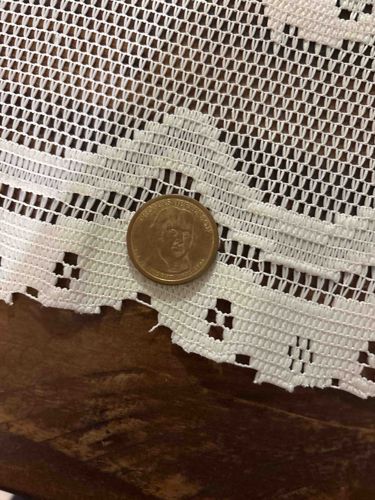
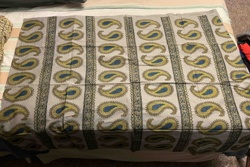
The primary item in focus is a golden-colored coin, appearing to be a Sacagawea or Native American dollar coin from the United States. The coin exhibits a metallic, likely copper-manganese brass, composition, giving it a distinct golden hue. One side of the coin, which is visible, features a portrait of a person, identifiable as Sacagawea or a generic Native American figure depending on the specific series. The inscription "LIBERTY" is visible above the portrait, and "IN GOD WE TRUST" is partially visible along the bottom edge. While the date is not clearly discernible, the design is consistent with dollar coins minted from 2000 onwards. The coin shows signs of circulation, with some light wear and possibly a slight patina that darkens the recesses of the design, but no severe damage such as deep scratches or dents are apparent. Its condition suggests it is a circulated coin rather than an uncirculated specimen. The coin is resting on a white textile surface, which appears to be a filet lace doily or tablecloth. This textile is characterized by its intricate openwork pattern, created by a series of knotted or woven threads forming a grid-like mesh. The pattern features geometric shapes, including squares and possibly more elaborate motifs within the lace design. The edges of the lace are scalloped or have a decorative finish, consistent with traditional lacework. The background shows a dark, possibly wooden, surface beneath the lace, providing a contrast that highlights the white textile. The craftsmanship of the lace appears to be hand-done or machine-made to replicate a hand-made look, indicating a vintage or traditional style. No specific maker's marks or signatures are visible on either the coin or the lace.
AI Appraisal Report
I have examined the provided image of a Sacagawea / Native American Dollar Coin resting on a filet lace doily. My appraisal focuses on two distinct items: the coin and the textile.
The coin appears to be a standard Sacagawea or Native American dollar, likely from general circulation. Visually, it exhibits typical wear consistent with a circulated coin, with light abrasions but no significant damage. The inscription "LIBERTY" and a partial "IN GOD WE TRUST" are visible, characteristic of these issues. Without a clear date or mint mark, and a physical inspection to assess luster, strike, and surface integrity, a precise numismatic grade is impossible. However, based on the image, it is a common circulating coin, not a rare variety or a high-grade specimen.
The filet lace doily appears to be a machine-made or mass-produced piece, common in domestic settings. The intricacy and pattern are typical of such items. While attractive, modern lace doilies generally do not hold significant antique or collectible value unless they possess exceptional hand-craftsmanship, historical provenance, or are made from rare materials. This example shows no unique characteristics that would elevate its value beyond a decorative household item.
Combined, these items do not present as a unique or historically significant collection. The coin's value is purely its face value with a slight premium for its uncirculated state (if applicable, which cannot be determined here) while the doily has minimal resale value.
For a definitive appraisal, a physical examination of the coin would be required to determine its exact date, mint mark, and a precise numismatic grade. The textile would need closer inspection for material composition, age, and true hand-made vs. machine-made determination. Based on the images alone, the monetary value of both items is low. The coin is likely worth its face value, possibly up to $3 if it were an uncirculated condition, and the doily would fetch only a few dollars at a flea market or thrift store.