This piece was likely purchased in Pakistan or India in the 1960s
These notes were written by the person who submitted this item. Appraiser.AI has not verified them, and the AI's identification and estimate may rely on them.
AI Estimated Value
Not an official valuation
$150-250
AI estimate as of July 8, 2025 · verify with a professional before acting
AI-Generated · Verify before acting
Everything on this page is generated by AI for informational purposes only. AI can make mistakes — the AI may misidentify items or misattribute them (artist, maker, brand, designer, origin, era). This is not an official valuation and should not be used for insurance, sale, tax, estate, legal, or lending purposes — or any decision requiring a certified appraisal. It is not an authoritative claim about any person, brand, or rights holder — do not share or rely on it as a factual statement about a third party. Always consult qualified professionals before making financial decisions.
This analysis also relies on unverified notes provided by the user, which may be incomplete or inaccurate and could affect the result.
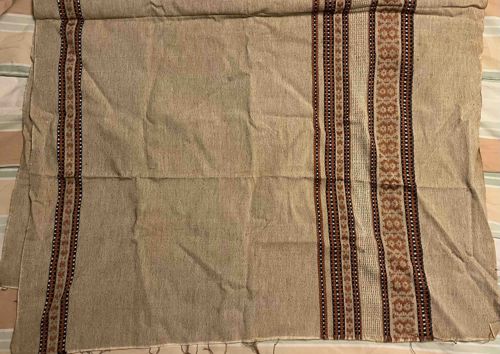
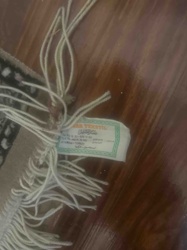
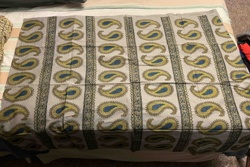
This item is a hand-loomed textile, likely a shawl or a large scarf, exhibiting a natural, earthy aesthetic. The primary color of the textile is a muted beige or light brown, characteristic of unbleached or minimally dyed natural fibers. The weave appears to be a plain or tabby weave, giving it a somewhat coarse and rustic texture with visible variations in thread thickness, indicating artisanal craftsmanship rather than mass production. There are prominent decorative bands running lengthwise. On the far left, a single, narrower band consists of alternating dark brown (possibly deep maroon or black) and light brown/beige woven patterns. Towards the right side, there is a wider central decorative section composed of multiple vertical stripes. This section features a central, broader stripe with a complex geometric motif in a lighter brown or tan, resembling interlocking or repeating octagonal shapes, flanked by narrower stripes of the dark brown and light brown/beige pattern similar to the one on the far left. The arrangement of these stripes creates an asymmetrical but balanced design. The edges of the textile, particularly the bottom visible edge, show fringe or unfinished selvage, consistent with traditional handwoven pieces. The overall condition appears good, with some crinkling and folds suggesting it has been stored or used, but no obvious tears, significant stains, or major wear are discernible from the image. The colors seem consistent, without significant fading. Given the context of a 1960s purchase in Pakistan or India, this textile likely dates to the mid-20th century and represents traditional weaving techniques from that region. The craftsmanship appears to be of good quality for a handmade item, showcasing careful attention to the patterned areas.
AI Appraisal Report
Upon examining the provided image and considering the details of its acquisition in Pakistan or India during the 1960s, I assess this hand-loomed textile to be a charming example of traditional South Asian weaving. The craftsmanship, characterized by its plain or tabby weave and visible variations in thread thickness, strongly supports its handmade nature and authenticity. The geometric bands, particularly the complex octagonal motifs, are consistent with regional patterns. Its condition appears good, with minor crinkling, but no obvious tears or significant stains, indicating careful preservation over the decades. The natural, earthy tones and seemingly undyed fibers enhance its rustic appeal.
From a market perspective, traditional South Asian textiles of this era are generally appreciated for their artisanal qualities and cultural significance. While not inherently rare, well-preserved examples with appealing patterns do command interest. The demand is niche, typically among collectors of ethnic textiles, folk art, or those seeking unique decorative accents. Comparables often include similar handwoven shawls or narrow loom pieces from the mid-20th century, which can range widely in value depending on intricacy, fiber content (though here it appears to be a common natural fiber), and provenance. Factors impacting value positively include its age, apparent good condition, and the clear handmade aesthetic. Its specific sizing (shawl/large scarf) makes it versatile.
My primary limitation in this appraisal is the lack of physical examination. While the image suggests authenticity and good condition, a hands-on inspection would allow me to confirm fiber composition, assess the integrity of the weave more thoroughly, detect any subtle repairs or wear not visible, and verify the quality of the dyes. For absolute authentication and a precise valuation, physical examination, and potentially provenance documentation (such as original sales receipts, though not expected for an item of this type and age) would be beneficial. Scientific testing of fibers or dyes is typically beyond the scope required for items of this nature unless questions of origin or age arise more critically.