AI estimate as of December 13, 2025 · verify with a professional before acting
AI-Generated · Verify before acting
Everything on this page is generated by AI for informational purposes only. AI can make mistakes — the AI may misidentify items or misattribute them (artist, maker, brand, designer, origin, era). This is not an official valuation and should not be used for insurance, sale, tax, estate, legal, or lending purposes — or any decision requiring a certified appraisal. It is not an authoritative claim about any person, brand, or rights holder — do not share or rely on it as a factual statement about a third party. Always consult qualified professionals before making financial decisions.
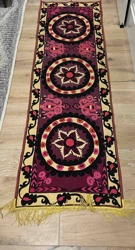
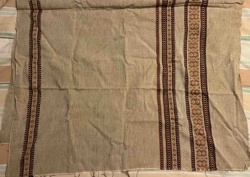
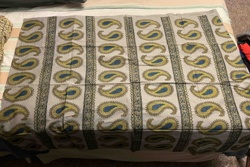
The item is a textile, likely a rug, mat, or blanket, featuring visible fringed edges and a manufacturing label attached. The fringe appears to be made of off-white or cream-colored twisted yarn, consistent with natural fibers like cotton or wool, which are commonly used in traditional textiles. The main body of the textile, partially visible, shows a dark patterned section and a lighter, possibly beige or tan, solid area, suggesting a decorative design. The fringe elements are numerous and moderately dense, indicating a finished edge for the textile. The most prominent feature is a rectangular paper or fabric label, predominantly white with a light green border, stitched or stapled to the fringe. The label clearly bears text, with 'TEKSTIL' and 'İSTANBUL - TURKEY' discernible, indicating its origin. The script above 'TEKSTIL' appears to be 'AKAR', making the manufacturer 'AKAR TEKSTIL'. Other text includes numerical sequences, likely an address ('Sk No 12 33-500 N 42') or product identifier. The label itself appears to be in good condition, with crisp edges and legible print, though some creases are visible. The fibers of the fringe show minimal signs of wear or discoloration, suggesting the item is either relatively new or well-preserved. The textile's pattern and construction hint at a traditionally crafted piece, typical of Turkish textile manufacturing. The overall impression is one of quality craftsmanship, with attention to detail in the finishing of the fringe and the clear branding on the label.
AI Appraisal Report
Based on my visual examination of the provided image, I assess this Turkish textile to be in very good condition. The fringed edges appear clean and intact, showing minimal signs of wear or discoloration. The attached manufacturer's label, 'AKAR TEKSTIL, İSTANBUL - TURKEY,' is clearly legible and well-preserved, suggesting either recent manufacture or careful storage. The visible portion of the textile indicates a decorative pattern, typical of Turkish textile craftsmanship.
autenticity, the label strongly suggests genuine Turkish origin. However, without a physical inspection, I cannot fully verify the material composition (e.g., cotton, wool, or synthetics) or the precise weave quality. These factors can significantly influence value. The presence of a clear manufacturer's label positions this more as a commercially produced item rather than a unique, hand-knotted antique piece.
In terms of market conditions, similar contemporary Turkish textiles, especially those from known manufacturers, typically fall into the modest price range. Comparables would include new or lightly used decorative rugs, mats, or throws available through import retailers or online marketplaces. Demand for such items is generally moderate, driven by interior design trends. Rarity is not a significant factor here, as the item appears to be a mass-produced or commercially available product.
Limitations in authenticity verification from images alone are substantial. I cannot feel the texture, assess the yarn quality, or examine the reverse side for construction details crucial to determining true craftsmanship and material. For full authentication and a more precise valuation, an in-person examination would be necessary to assess fiber type, dye quality, knot count (if a rug), and overall structural integrity. Provenance documentation, though less critical for a contemporary manufactured piece, could still offer additional context.