AI estimate as of July 6, 2025 · verify with a professional before acting
AI-Generated · Verify before acting
Everything on this page is generated by AI for informational purposes only. AI can make mistakes — the AI may misidentify items or misattribute them (artist, maker, brand, designer, origin, era). This is not an official valuation and should not be used for insurance, sale, tax, estate, legal, or lending purposes — or any decision requiring a certified appraisal. It is not an authoritative claim about any person, brand, or rights holder — do not share or rely on it as a factual statement about a third party. Always consult qualified professionals before making financial decisions.
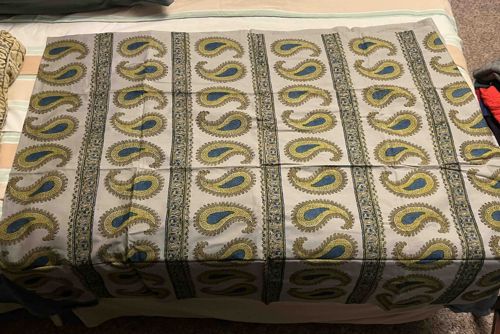
This item is a rectangular piece of printed fabric, likely cotton or a cotton blend, exhibiting a repeating pattern. The dominant design is the classic paisley motif, arranged in vertical rows. Each paisley motif features a deep teal or dark blue center, surrounded by a border of chartreuse green or olive-yellow, outlined with a fine dark line. The paisleys are consistently oriented and spaced. Between these vertical rows of paisleys are narrower vertical stripes. These stripes appear to be dark grey or black with intricate, lighter-colored traditional patterns, possibly indicating block printing or another traditional textile printing method. The background color of the fabric is a light cream or off-white. The fabric appears to be folded, as evidenced by a prominent horizontal crease in the middle, suggesting it may have been stored or packaged in this manner. There are no immediately visible signs of significant wear, tears, stains, or repairs, though a full assessment of condition would require unfolding the piece. The overall craftsmanship seems to be of a good standard, with clear and consistent print registration. The style suggests it could be an antique or vintage piece, possibly dating from the late 19th through mid-20th century, given the traditional nature of the paisley and stripe patterns. It does not appear to have any visible maker's marks or signatures in the current view. The size cannot be precisely determined from the image, but it appears to be a substantial piece of fabric, perhaps intended for upholstery, drapery, or a large throw.
AI Appraisal Report
I have examined the provided image of this Printed Paisley and Stripe Textile. Visually, the condition appears excellent; I observe no significant tears, stains, or repairs, though the prominent horizontal crease indicates it has been folded. A full condition assessment would require unfolding and in-person inspection. The print registration is clear and consistent, suggesting good craftsmanship. Authenticity, based solely on the image, points to a vintage or antique textile, likely late 19th to mid-20th century, given the traditional design. However, definitive dating and fiber content would require physical examination, potentially including fiber analysis and microscopic inspection of the print. Without maker's marks or provenance, full authentication is limited.
Regarding market conditions, traditional textile patterns like paisley remain popular, especially for decorative applications such as throws, pillows, or framing. Comparable vintage printed cottons of this apparent quality and size typically range from affordable to moderate, depending on age, origin, and specific design rarity. While not unique, the specific color palette (teal, chartreuse, cream) and intricate stripe detailing elevate its appeal. Demand for well-preserved vintage textiles is consistent, but rarity for this specific pattern is hard to ascertain without further research. The primary factors impacting value here are its excellent visual condition, appealing design, and potential age. The lack of provenance or distinct maker identification, and the inability to confirm fiber content or exact age without physical examination, are value limitations. For full authentication, I'd need to physically inspect the weave, fiber, print technique, and scrutinize for hidden marks.