Southwest Style Flat-Woven Textile
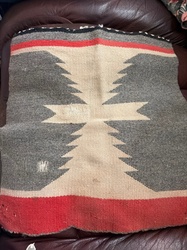
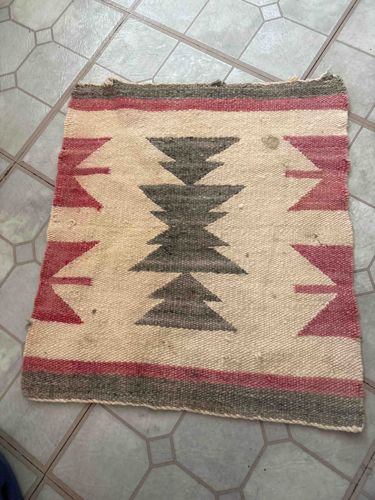
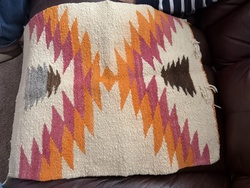
This is a rectangular flat-woven textile, likely a small rug or saddle blanket, featuring a traditional Southwestern-inspired aesthetic. The piece is hand-woven with a heavy, coarse wool yarn over a sturdy warp, typical of Kilim or Navajo-style flatweaves. The color palette consists of a cream or off-white ground, accented with a center stacked-diamond or 'terrace mountain' motif in charcoal grey. Flanking the sides are partial serrated diamond motifs in a muted brick red. The top and bottom are finished with solid horizontal bands of grey and red. Regarding condition, the textile shows signs of age and significant use; there is visible staining—most notably a circular brown spot in the upper-right cream field—and general surface grime throughout. The edges exhibit fraying and loss of original structural integrity, particularly at the corners and top edge. The weave is loose in several areas with some exposed warp threads, suggesting a mid-to-late 20th-century vintage origin. The uneven selvedges and varied thickness of the yarn indicate hand-made craftsmanship, though the specific regional origin remains unattributed without maker marks.
AI-Generated Appraisal Disclaimer
Estimated Value
$150 - $250
Basic Information
Category
Textiles and Rugs
Appraised On
March 25, 2026
Estimated Value
$150 - $250
Item Description
This is a rectangular flat-woven textile, likely a small rug or saddle blanket, featuring a traditional Southwestern-inspired aesthetic. The piece is hand-woven with a heavy, coarse wool yarn over a sturdy warp, typical of Kilim or Navajo-style flatweaves. The color palette consists of a cream or off-white ground, accented with a center stacked-diamond or 'terrace mountain' motif in charcoal grey. Flanking the sides are partial serrated diamond motifs in a muted brick red. The top and bottom are finished with solid horizontal bands of grey and red. Regarding condition, the textile shows signs of age and significant use; there is visible staining—most notably a circular brown spot in the upper-right cream field—and general surface grime throughout. The edges exhibit fraying and loss of original structural integrity, particularly at the corners and top edge. The weave is loose in several areas with some exposed warp threads, suggesting a mid-to-late 20th-century vintage origin. The uneven selvedges and varied thickness of the yarn indicate hand-made craftsmanship, though the specific regional origin remains unattributed without maker marks.
Get Your Items Appraised
Instant estimates of your treasures with AI-powered instant appraisals