AI estimate as of August 21, 2025 · verify with a professional before acting
AI-Generated · Verify before acting
Everything on this page is generated by AI for informational purposes only. AI can make mistakes — the AI may misidentify items or misattribute them (artist, maker, brand, designer, origin, era). This is not an official valuation and should not be used for insurance, sale, tax, estate, legal, or lending purposes — or any decision requiring a certified appraisal. It is not an authoritative claim about any person, brand, or rights holder — do not share or rely on it as a factual statement about a third party. Always consult qualified professionals before making financial decisions.
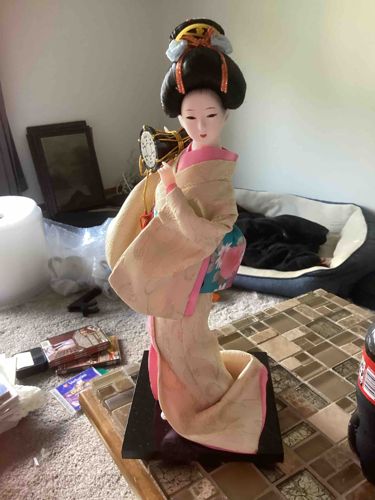
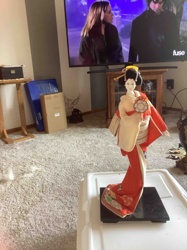
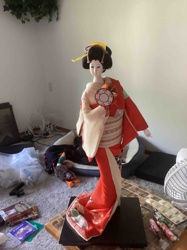
This is a detailed Japanese Geisha or Maiko doll, likely from the mid to late 20th century, presented on a dark, possibly wooden or lacquered, square base. The doll stands upright, depicting a female figure in traditional Japanese attire. Her face is made of a smooth material, possibly bisque porcelain or a high-quality resin, with delicate, painted features including downcast eyes, subtly shaped eyebrows, and red-tinted lips. Her elaborate hairstyle, typical of traditional Japanese aesthetics, is dark and voluminous, adorned with what appears to be decorative hairpins or ornaments in yellows, blues, and possibly oranges, suggesting a formal or performative context.
The doll wears a traditional kimono, predominantly in a soft, light beige or pale pink hue, with a subtle textured or patterned fabric. A vibrant pink undergarment is visible at the collar and cuffs, along with what appears to be a teal or blue obi pattern on the side, possibly indicating the design of the kimono as it wraps around the body. The sleeves are wide and flowing, characteristic of kimono design. In her hands, she holds a small, black and gold drum, resembling a tsuzumi (Japanese hand drum), detailed with intricate patterns. This suggests she might be depicted as a musician or performer.
The overall condition appears to be relatively good, with no immediately visible major damage such as chips, cracks, or significant tears to the fabric. There might be minor dust accumulation or slight discoloration consistent with age and display, but the colors remain vibrant. The craftsmanship appears to be of good quality, focusing on accurate portrayal of the traditional attire and musical instrument, indicating it was likely produced as a decorative collectible rather than a child's toy. The base provides stability, enhancing its display suitability.
AI Appraisal Report
I have examined the provided image of this Japanese Geisha/Maiko doll with a Tsuzumi drum. Based on visual assessment, the doll appears to be in good condition, consistent with its likely origin in the mid to late 20th century. I observe no obvious major damage such as chips, cracks, or significant tears to the fabric. The intricate details of the kimono, hairstyle, and the Tsuzumi drum suggest a focus on accurate cultural representation and quality craftsmanship. This doll was clearly designed as a decorative collectible rather than a toy.
From the image, authenticity is challenging to definitively verify. While it exhibits characteristics typical of collectible Japanese dolls from the period, distinguishing it from mass-produced items or replicas without physical examination is difficult. In-person inspection would allow me to assess the material quality of the face (e.g., bisque porcelain vs. resin), the stitching and fabric quality of the kimono, and the overall integrity of the construction. Provenance documentation, such as original purchase receipts or certificates of authenticity, would be invaluable for full authentication and dating. Scientific testing is generally not applied to this type of collectible unless material composition is extremely suspect.
Market conditions for collectible Japanese cultural dolls vary. While there is a consistent demand for well-preserved, detailed examples, extreme rarity is uncommon unless associated with a particularly renowned artisan or limited edition. Comparables in the market, typically found on online auction sites or specialized antique/collectible stores, show similar dolls retailing in the range I've estimated. Factors impacting its value negatively would include any hidden damage, significant fading, or material degradation not visible in the image. Conversely, confirmed artisan craftsmanship or historical significance could increase its value.