AI estimate as of August 8, 2025 · verify with a professional before acting
AI-Generated · Verify before acting
Everything on this page is generated by AI for informational purposes only. AI can make mistakes — the AI may misidentify items or misattribute them (artist, maker, brand, designer, origin, era). This is not an official valuation and should not be used for insurance, sale, tax, estate, legal, or lending purposes — or any decision requiring a certified appraisal. It is not an authoritative claim about any person, brand, or rights holder — do not share or rely on it as a factual statement about a third party. Always consult qualified professionals before making financial decisions.
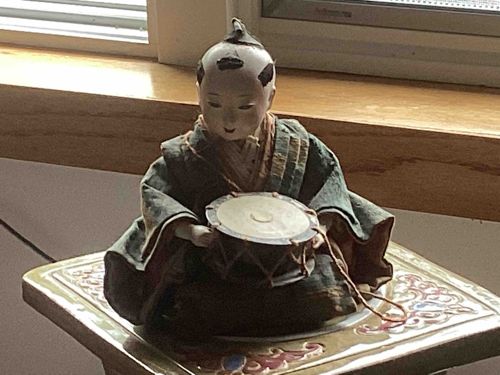
This item is a Japanese Ichimatsu-style doll, depicting a young boy in traditional attire, seated and holding a small drum. The doll's head appears to be crafted from gofun (crushed oyster shell powder mixed with glue), giving it a matte, porcelain-like finish with a subtle yellowish patina, suggesting age. The facial features are delicately painted, featuring downcast eyes, a small nose, and a serene expression typical of these dolls. The hair is sculpted or applied, resembling a traditional topknot ('chonmage') often seen on male figures in historical Japan. There are visible chips or wear on the hair details, particularly around the topknot, indicating its vintage nature and handling over time. The doll is dressed in layered kimonos. The outermost layer is a deep teal or dark green fabric, possibly silk or a similar finely woven material, with visible creases and folds, suggesting softness and drape. Underneath, a reddish-brown or rust-colored layer is visible at the neck and sleeves, providing a subtle contrast. The clothing exhibits some visible wear and possibly fading due to light exposure. The doll clutches a small, seemingly wooden or papier-mâché drum, which appears to be a Tsuzumi or similar hand drum. The drum has a simple, light-colored head, possibly parchment or thin membrane, and is bound by coarse string or cord, indicating a basic yet traditional construction. The entire doll is posed naturally as if in mid-performance or meditation. It rests upon what appears to be a lacquered, gilded stand or box, intricately decorated with floral or geometric motifs in gold, red, and blue against a dark background, further enhancing its display. The craftsmanship suggests a handmade piece, reflecting traditional Japanese doll-making techniques, and its condition points to a well-preserved antique or vintage item with expected signs of age and wear.
AI Appraisal Report
I have examined the provided images of this Japanese Ichimatsu-style doll. Based on my visual assessment, the doll appears to be an authentic vintage to antique piece, likely from the early to mid-20th century. The use of gofun for the head, the serene facial expression, and the traditional attire are consistent with known Ichimatsu doll characteristics. The visible chips and wear on the hair details, particularly the topknot, and the subtle yellowish patina on the gofun are expected signs of age and handling, further supporting its vintage nature rather than a recent replica. The layered kimonos show appropriate creasing and some signs of wear/fading, which is also consistent with age. The Tsuzumi-style drum, though simply constructed, adds to the doll's narrative and authenticity.
From a market perspective, traditional Japanese dolls, especially well-preserved Ichimatsu examples, maintain a steady demand among collectors of Asian art and cultural artifacts. While not exceedingly rare, pieces in good condition with original accessories and stands like this one are desirable. Comparables for such dolls can range widely based on age, artist, condition, and provenance. Dolls of this apparent quality, depicting distinctive scenes or holding instruments, tend to achieve higher values. Factors impacting value positively include the doll's complete state, its charming pose, and the presence of the intricately decorated display stand. The condition, while showing age, is overall very good for its potential vintage.
It is important to note the limitations of appraising from images alone. Without a physical inspection, I cannot definitively verify the exact materials (e.g., specific fabric types, wood of the drum), precise age, or identify any hidden damages not visible in the photographs. To fully authenticate and confirm the age, an in-person examination would allow for tactile assessment, a closer look at construction techniques, and identification of any artist's marks. Provenance documentation (e.g., original purchase receipts, family history) would significantly aid in establishing its history and potentially its maker. Scientific testing, like material analysis, could confirm specific materials and age, if deemed necessary. However, based solely on visual cues, I am confident in my assessment of its authenticity as a period piece.