AI estimate as of August 21, 2025 · verify with a professional before acting
AI-Generated · Verify before acting
Everything on this page is generated by AI for informational purposes only. AI can make mistakes — the AI may misidentify items or misattribute them (artist, maker, brand, designer, origin, era). This is not an official valuation and should not be used for insurance, sale, tax, estate, legal, or lending purposes — or any decision requiring a certified appraisal. It is not an authoritative claim about any person, brand, or rights holder — do not share or rely on it as a factual statement about a third party. Always consult qualified professionals before making financial decisions.
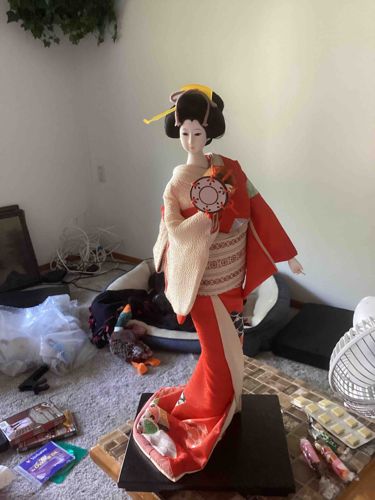
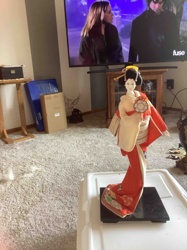
This appears to be a Japanese Geisha or Maiko doll, likely from the mid to late 20th century. The doll stands upright on what seems to be a solid black rectangular base, suggesting it is a display piece. Its construction includes a stylized head with a delicate facial expression, featuring painted eyes, eyebrows, and lips, indicating a traditional Japanese aesthetic. The hair is styled in a classic black updo, adorned with yellow decorative elements, possibly representing kanzashi (hair ornaments). The doll is dressed in a vibrant kimono, primarily red with a white inner lining that cascades elegantly to the base. The red fabric of the kimono features subtle floral or nature-inspired patterns near the hem. The obi (sash) is a contrasting lighter color, possibly cream or light beige, with intricate woven patterns. The sleeves of the kimono are wide and flowing, typical of traditional Japanese attire. The doll holds a small, round, drum-like object, which is white with reddish-brown decorative patterns, featuring a string handle, suggesting it's a taiko drum or similar musical instrument accessory. The materials likely include porcelain or composition for the head and hands, with richly textured fabrics such as silk or satin blend for the kimono. There are no immediate visible signs of significant damage or wear, although the image quality does not allow for a close inspection of subtle patina or fabric degradation. The craftsmanship appears to be of reasonable quality, with attention to detail in the costume and facial features.
AI Appraisal Report
Based on my visual examination of the provided image, this Japanese Geisha or Maiko doll appears to be in very good condition. The vibrant colors of the kimono are well-preserved, and there are no immediately apparent rips, tears, or significant staining. The head and hands, likely porcelain or composition, show no visible chips or cracks. The intricate details of the hair ornaments and the taiko drum accessory suggest careful handling and display. Authentication of the doll's age and origin, beyond what is visually discernible, is limited without a physical inspection. I would need to examine the craftsmanship up close, particularly the material quality of the skin and hair, the type of adhesive used, and any manufacturer markings on the base or hidden areas of the doll for a more definitive assessment. Provenance documentation, such as purchase receipts or family history, would also be invaluable.
In terms of market conditions, dolls of this type, especially those from the mid to late 20th century, generally fall within the collectible rather than antique category. While there's a steady demand, particularly for well-preserved examples, extreme rarity is uncommon for mass-produced or widely available dolls from this period. Comparables on online auction sites and specialized doll forums indicate a broad range depending on condition, size, and perceived artistry. The presence of the taiko drum enhances its display appeal. Factors significantly impacting value include the doll's condition, the quality of its materials (e.g., silk vs. synthetic kimono), the level of detail in its construction, and its size. Authenticity verification limitations solely from images mean I cannot confirm the exact materials, nor can I rule out subtle condition issues like minor fading or dust accumulation that would only be visible with an in-person examination.