AI estimate as of August 17, 2025 · verify with a professional before acting
AI-Generated · Verify before acting
Everything on this page is generated by AI for informational purposes only. AI can make mistakes — the AI may misidentify items or misattribute them (artist, maker, brand, designer, origin, era). This is not an official valuation and should not be used for insurance, sale, tax, estate, legal, or lending purposes — or any decision requiring a certified appraisal. It is not an authoritative claim about any person, brand, or rights holder — do not share or rely on it as a factual statement about a third party. Always consult qualified professionals before making financial decisions.
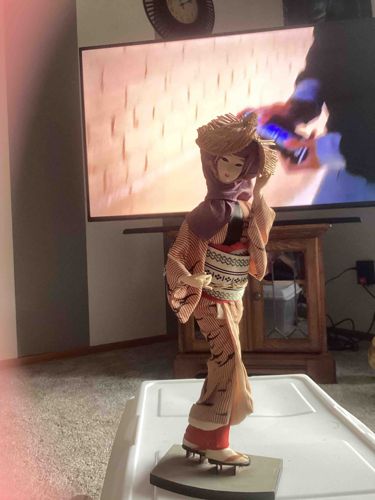
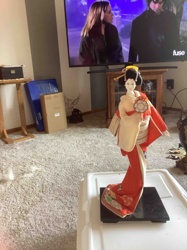
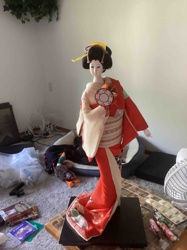
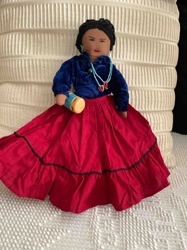
This is a detailed Japanese geisha or maiko doll, likely late 20th century, standing approximately 12-18 inches tall on a rectangular dark base. The doll features a realistically sculpted face with painted features, including delicate eyes and lips. Her hair is covered by a reddish-purple hood or headscarf, over which a finely woven straw hat, possibly a sugegasa, is positioned. She is dressed in a traditional kimono made of what appears to be silk or a silk blend fabric. The kimono primarily features a light peach or beige color with a repeating pattern of thin, vertical reddish-brown stripes and small dark bird-like motifs. An elaborate obi (sash) cinches the waist, showcasing a horizontal black and white geometric pattern with small red accents. The doll's hands are delicately posed, one appearing to adjust the straw hat. The feet are clad in white socks (tabi) and traditional geta (wooden clogs) with red straps, elevated on the base by small supports integrated into the geta. While the overall condition appears good from the visible angles, specific wear or damage is not discernible without closer inspection. The craftsmanship indicates a decorative collector's item, primarily for display. No visible maker's marks or signatures are apparent in the provided image.
AI Appraisal Report
Upon visual examination of the provided image, I assess this Japanese Geisha or Maiko doll to be in good overall condition. The intricate details of the kimono, obi, and straw hat suggest a decorative collector's item, likely from the late 20th century. The sculpted face and delicate posing indicate quality craftsmanship. Without a physical inspection, however, I cannot definitively assess wear, fading, or minor damages, nor can I confirm the exact materials, such as whether the kimono is true silk or a blend. Market conditions for Japanese cultural dolls of this type often depend on intricacy, age, and provenance. Comparable dolls of similar size and detail, particularly those marketed as decorative art rather than antique, typically fetch values reflecting their artistic merit and condition. Demand for well-preserved, aesthetically pleasing Japanese dolls remains steady among collectors of Asian arts and cultural objects. While not extremely rare, dolls with such fine detail and apparent good condition are sought after. Factors significantly impacting its value include the actual material quality (e.g., silk vs. synthetic), the artistry of the hand-painting on the face, and indeed, its age. An authentic antique (pre-mid-20th century) would command a much higher price. Limitations in authenticity verification from images alone are profound. I cannot confirm maker's marks, materials, or internal construction. For full authentication and a more precise valuation, an in-person examination is crucial to assess material quality, internal structural integrity, and detect any subtle repairs or damage. Provenance documentation, such as original purchase receipts or historical ownership records, would also significantly enhance its verifiable history and value.