AI estimate as of July 19, 2025 · verify with a professional before acting
AI-Generated · Verify before acting
Everything on this page is generated by AI for informational purposes only. AI can make mistakes — the AI may misidentify items or misattribute them (artist, maker, brand, designer, origin, era). This is not an official valuation and should not be used for insurance, sale, tax, estate, legal, or lending purposes — or any decision requiring a certified appraisal. It is not an authoritative claim about any person, brand, or rights holder — do not share or rely on it as a factual statement about a third party. Always consult qualified professionals before making financial decisions.
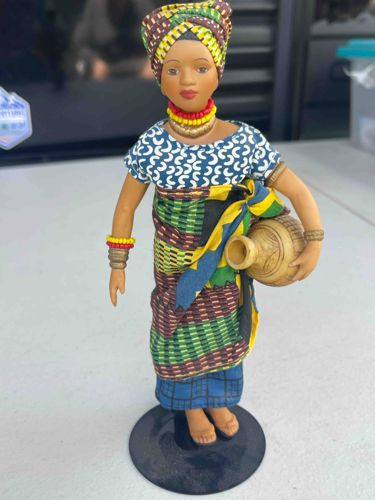
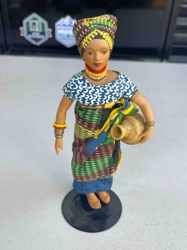
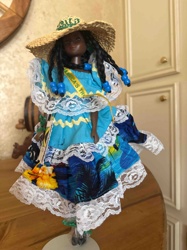
This is a detailed figurine, likely handcrafted, portraying an African woman. The figure stands approximately 10-12 inches tall based on the visible proportions, resting on a circular black base. The material for the body appears to be a composite or molded clay, possibly terracotta or a resin, given its matte finish and subtle coloration that mimics skin tones. The face is delicately painted with features including eyes, eyebrows, nose, and distinct red lips, indicating careful craftsmanship. Her head is adorned with a vibrant, multi-patterned headwrap, predominantly featuring shades of green, yellow, brown, and possibly blue, arranged in a traditional style. She is dressed in colorful fabric clothing: a blue and white patterned top with short sleeves featuring a crescent or 'C' shape motif, and a layered skirt. The upper layer of the skirt is a woven-looking fabric in green, brown, and yellow stripes (possibly kente cloth inspired), tied with a sash that includes blue and yellow elements. Beneath that, a blue plaid or checkered fabric forms the lower part of the skirt.
Accessories include a red and yellow bead necklace, yellow and red beaded bracelets on one wrist, and brown bangles on the other. In her left arm, she cradles a small, light-brown, carved pot or jug, which exhibits carved decorative patterns on its surface, suggesting it might be made of wood or a similar molded material. The quality of the clothing indicates attention to detail, using actual textiles rather than painted-on details, which adds to its authenticity and aesthetic appeal. The figure displays no obvious signs of significant damage like chips or cracks; the clothing appears cleanly draped, and colors are vibrant. The base shows minor scuffing, consistent with tabletop display. The overall style suggests a piece of African folk art or a cultural doll, likely from the late 20th century to early 21st century.
AI Appraisal Report
Based on my visual examination of the provided image, this African Woman Figurine with Water Pot appears to be in excellent overall condition. The delicate painting on the face, the vibrant multi-patterned headwrap, and the use of actual textile clothing (including what appears to be kente cloth inspired fabric) demonstrate a high level of craftsmanship and attention to detail. The lack of obvious chips, cracks, or significant wear on the figure itself, coupled with the clean drape and vibrant colors of the clothing, suggests careful preservation. The minor scuffing on the black base is consistent with typical display and does not detract significantly from its aesthetic appeal. I assess its authenticity as a cultural doll or folk art figurine, likely from the late 20th to early 21st century, is probable given the style and materials.
In terms of market conditions, similar handcrafted cultural figurines and dolls, particularly those featuring detailed fabric work and composite materials, tend to appeal to collectors of ethnic art, folk art, and decorative home accents. While not a rare antique, the piece exhibits good quality that can command a respectable price. Comparables for such items often appear in online artisan marketplaces, specialized cultural gift shops, and small antique/collectible stores. Demand for well-crafted, culturally representative pieces remains steady. Factors positively impacting its value include the detailed craftsmanship, the use of actual textiles, and its well-preserved condition. Its approximate 10-12 inch height makes it a good display piece.
It is important to note the limitations of assessing authenticity and precise origin from images alone. Without physical examination, I cannot definitively confirm the precise material composition (e.g., specific type of composite, resin, or terracotta) or ascertain if there are any hidden structural defects or repairs. In-person examination would allow for closer inspection of seams, material texture, and weight, which could provide further clues regarding its fabrication technique and origin. Additionally, provenance documentation (e.g., artist's signature, original receipts, or certificates of authenticity) would be crucial for a definitive authentication of origin or artist attribution. Scientific testing of materials, if deemed necessary for high-value items, would also require physical access. However, for a decorative folk art piece, visual assessment is often sufficient for general appraisal purposes.