AI estimate as of August 21, 2025 · verify with a professional before acting
AI-Generated · Verify before acting
Everything on this page is generated by AI for informational purposes only. AI can make mistakes — the AI may misidentify items or misattribute them (artist, maker, brand, designer, origin, era). This is not an official valuation and should not be used for insurance, sale, tax, estate, legal, or lending purposes — or any decision requiring a certified appraisal. It is not an authoritative claim about any person, brand, or rights holder — do not share or rely on it as a factual statement about a third party. Always consult qualified professionals before making financial decisions.
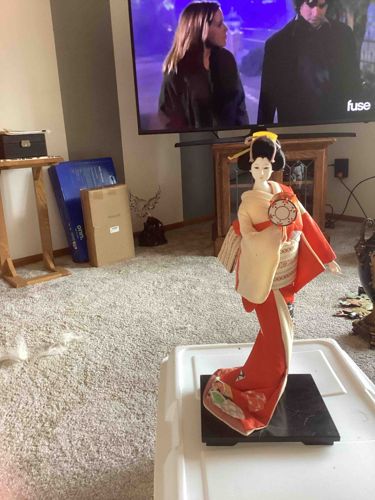
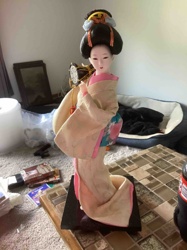
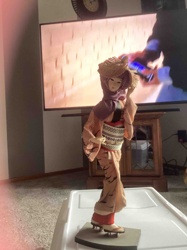
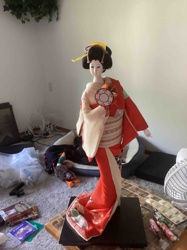
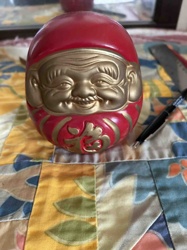
This is a detailed Japanese geisha or maiko doll, likely made from plaster, papier-mâché, or composition for the head and hands, with a fabric-covered body and traditional silk or satin clothing. The doll stands on a black, rectangular base, possibly lacquered wood or plastic, giving it stability. It appears to be of a medium size, suitable for display on a shelf or table. The doll is dressed in an elaborate kimono. The primary color of the kimono is a vibrant orange or red-orange, with an inner layer of white/cream fabric. The sleeves and hem show patterns or accents in green and possibly gold. The white fabric, likely representing an under-kimono or obiage, has subtle textured patterns. The obi (sash) is white with horizontal gold or muted orange stripes, tied at the back. The doll’s hair is styled in a traditional bun with black hair, accented with a yellow ornament or hairpiece. The facial features are delicately painted, characteristic of traditional Japanese dolls, with fair skin, closed or downcast eyes, and small, red lips. In her right hand, the doll holds a circular object, possibly a traditional fan (sensu) or a drum (tsuzumi). The overall condition appears to be good for display, although textiles in general are prone to dust accumulation and potential fading over time. There are no immediate visible signs of major damage or wear, and the clothing drapes naturally, indicating quality craftsmanship. Such dolls are typically from the mid-20th century to present, often made as souvenirs or decorative items embodying Japanese culture. The quality of the fabric and detail in the construction suggest it is not a mass-produced toy, but rather a more carefully crafted collectible.
AI Appraisal Report
Based on my visual examination of the provided image, this Japanese Geisha/Maiko doll appears to be in very good condition for a decorative piece of its type. The textiles show good drape and color saturation, with no immediately visible tears, significant fading, or extensive dust accumulation. The facial features are delicately painted, and the hair styling appears intact. The circular object in her hand, likely a fan or drum, adds to the authenticity of her pose. No major damage or wear is evident, suggesting it has been well-preserved.
From the image alone, authenticity regarding its exact origin or artisan is limited. These types of dolls are typically made for souvenir, decorative, or collectible purposes, ranging from the mid-20th century to contemporary production. The quality of the fabric and apparent craftsmanship suggest it's not a cheaply mass-produced item but rather a more carefully crafted piece. Market comparables for similar well-preserved Japanese collectible dolls often fall within a moderate range. Demand for such items is consistent among collectors of Japanese cultural artifacts or decorative arts, but they are not exceptionally rare.
The primary factors impacting value are its condition, the level of detail and quality of materials, and its aesthetic appeal. Without physical inspection, I cannot ascertain the exact materials of the head and hands (plaster, papier-mâché, composition), nor can I check for any hidden damage, odors, or the stability of internal components. Full authentication would require in-person examination to verify material composition, a detailed inspection of craftsmanship, and ideally, any provenance documentation (e.g., original packaging, acquisition records, artisan signature if applicable) to confirm its origin and age. Scientific testing is generally not applied to items of this nature for authentication unless there's a specific art historical claim.
My valuation is based purely on the visual information provided and assumes the condition observed is representative of the entire item.