Tudor Revival Style Oak Sideboard / Hunt Board
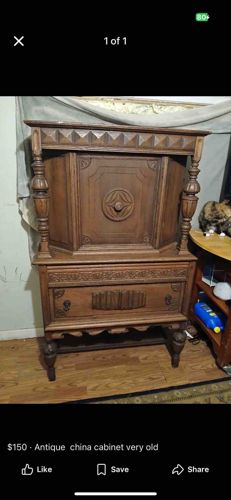
This is a substantial piece of case furniture featuring Tudor Revival (often called Jacobean Revival) styling, likely dating from the early-to-mid 20th century (circa 1920-1940). The piece is constructed from oak with a medium brown finish. The upper section features a central recessed door with a circular floral medallion and octagonal geometric paneling, flanked by canted side panels and supported by thick, bulbous turned pillars with gadrooned details. The top frieze is decorated with a series of carved pyramidal bosses (diamond points). The lower section contains a wide drawer featuring a carved foliate frieze along its top edge, a central reeded or fluted panel, and small metal circular drop pulls. The unit is supported by heavy bulbous turned legs connected by a low stretcher, ending in bun or block feet. The condition appears fair to good for its age, showing visible surface wear, small scratches, and light scuffing, particularly around the base and edges. The craftsmanship exhibits characteristic mass-manufactered revival era qualities such as machine-carved details and mixed wood construction typical of American or British furniture manufacturers of the Depression era. No visible maker's marks are discernible from the image, but the style is highly representative of the 'Grand Rapids' style popular in the United States during the 1920s.
AI-Generated Appraisal Disclaimer
Estimated Value
$400 - $700
Basic Information
Category
Antique Furniture / Case Goods
Appraised On
January 11, 2026
Estimated Value
$400 - $700
Item Description
This is a substantial piece of case furniture featuring Tudor Revival (often called Jacobean Revival) styling, likely dating from the early-to-mid 20th century (circa 1920-1940). The piece is constructed from oak with a medium brown finish. The upper section features a central recessed door with a circular floral medallion and octagonal geometric paneling, flanked by canted side panels and supported by thick, bulbous turned pillars with gadrooned details. The top frieze is decorated with a series of carved pyramidal bosses (diamond points). The lower section contains a wide drawer featuring a carved foliate frieze along its top edge, a central reeded or fluted panel, and small metal circular drop pulls. The unit is supported by heavy bulbous turned legs connected by a low stretcher, ending in bun or block feet. The condition appears fair to good for its age, showing visible surface wear, small scratches, and light scuffing, particularly around the base and edges. The craftsmanship exhibits characteristic mass-manufactered revival era qualities such as machine-carved details and mixed wood construction typical of American or British furniture manufacturers of the Depression era. No visible maker's marks are discernible from the image, but the style is highly representative of the 'Grand Rapids' style popular in the United States during the 1920s.
Get Your Items Appraised
Instant estimates of your treasures with AI-powered instant appraisals