These notes were written by the person who submitted this item. Appraiser.AI has not verified them, and the AI's identification and estimate may rely on them.
AI Estimated Value
Not an official valuation
$50 - $150
AI estimate as of December 15, 2025 · verify with a professional before acting
AI-Generated · Verify before acting
Everything on this page is generated by AI for informational purposes only. AI can make mistakes — the AI may misidentify items or misattribute them (artist, maker, brand, designer, origin, era). This is not an official valuation and should not be used for insurance, sale, tax, estate, legal, or lending purposes — or any decision requiring a certified appraisal. It is not an authoritative claim about any person, brand, or rights holder — do not share or rely on it as a factual statement about a third party. Always consult qualified professionals before making financial decisions.
This analysis also relies on unverified notes provided by the user, which may be incomplete or inaccurate and could affect the result.
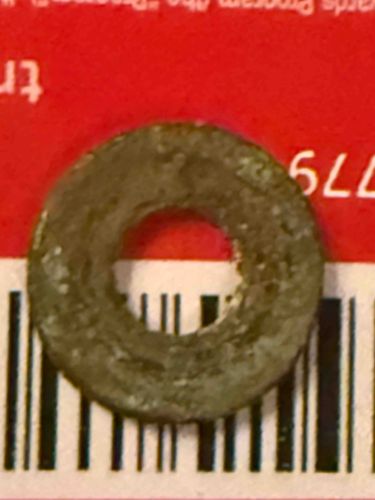
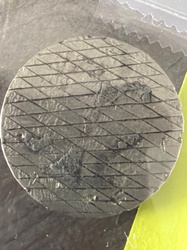
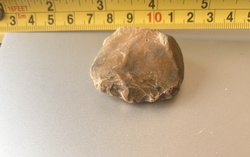
The item depicted appears to be a small, circular, disc-shaped object with a central perforation, suggesting it could be an ancient spindle whorl or a large bead. Its physical characteristics reveal a weathered, dark greenish-brown patina, consistent with aged bronze or a similar copper alloy. The texture of the surface is uneven and pitted, indicating significant corrosion or erosion from prolonged exposure to elements, possibly from being buried. There are no discernible markings, inscriptions, or decorative elements that would suggest a specific culture, period, or maker's mark; however, the rough finish hints at a utilitarian or early artisanal origin rather than highly refined craftsmanship. The edges are somewhat irregular and blunted, not sharply defined, which further supports its age and the effects of wear. The central hole is also not perfectly circular, exhibiting some asymmetry. Without precise measurements, it's difficult to determine its exact size, but relative to the barcode background, it appears to be a few centimeters in diameter. The item's condition indicates considerable age and a history of environmental interaction, which has resulted in a textured, somewhat crusty surface. The lack of any identifiable features makes pinpointing its exact age or style period challenging, but its appearance is consistent with artifacts recovered from archaeological sites. The overall quality is robust but unrefined.
AI Appraisal Report
I have examined the image of the circular, perforated object, which the owner describes as an "Old coin." Based on its physical characteristics, it appears to be an ancient spindle whorl or a large bead, rather than a coin. The weathered, dark greenish-brown patina and pitted, uneven surface are highly consistent with an aged bronze or copper alloy artifact subjected to environmental exposure, likely burial. The rough finish, irregular edges, and asymmetrical central hole suggest early utilitarian craftsmanship. Its condition indicates significant age and interaction with its environment, resulting in a robust but unrefined appearance.
Authenticity, based solely on this image, seems plausible as an ancient artifact, given the typical signs of age and corrosion. However, the lack of any distinguishing features like inscriptions, decorative elements, or specific stylistic cues makes definitive cultural or chronological attribution impossible without further information. This directly impacts market value, as highly identifiable artifacts command significantly higher prices. Factors impacting value include its plausible antiquity and material, but the general nature and lack of specific provenance detract from its potential high value. The market for generic ancient artifacts without clear attribution is limited, with demand primarily from hobbyists or educational institutions seeking examples of ancient technology rather than high-end collectors.
Without a clear provenance (origin and history), and given the lack of unique features, its rarity is difficult to ascertain. Comparables for generic ancient spindle whorls or beads typically fall into a modest price range. For full authentication, an in-person examination is crucial to assess surface details, weight, and material composition more thoroughly. Scientific testing, such as X-ray fluorescence (XRF) for elemental analysis, and metallography, could confirm the alloy and age. A detailed provenance document outlining its discovery would significantly enhance its value and confirm authenticity.