AI Appraisal Estimate

AI-generated estimates · not official valuations

From the user

What was submitted

Photo and notes provided by the user — not generated by AI

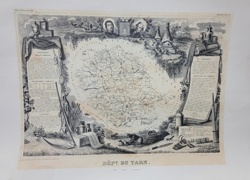
Submitted item photo
Submitted photo · June 13, 2026

User's notes

No additional notes provided.

AI analysis below

AI appraisal

AI analysis & estimate

AI-Generated · Verify before acting

Everything below is generated by AI for informational purposes only. AI can make mistakes — the AI may misidentify items or misattribute them (artist, maker, brand, designer, origin, era). This is not an official valuation and should not be used for insurance, sale, tax, estate, legal, or lending purposes — or any decision requiring a certified appraisal. It is not an authoritative claim about any person, brand, or rights holder — do not share or rely on it as a factual statement about a third party. Always consult qualified professionals before making financial decisions.

Read the full disclaimer

AI Identification

·Not independently authenticated·Verify before acting

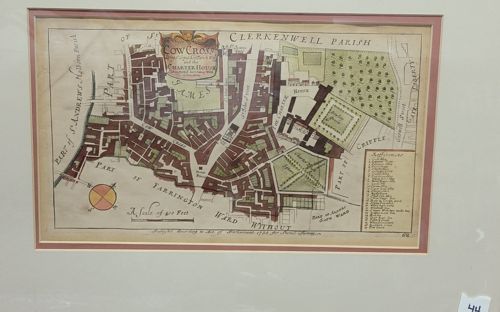
A Plan of Cow Cross and the Charter House, 1755 (Stow's Survey)

Antique Cartography & Maps

AI Estimated Value

·Not an official valuation·Verify before acting

$450.00 - $650.00

As of June 13, 2026

AI Item Analysis

·AI can make mistakes·Verify before acting
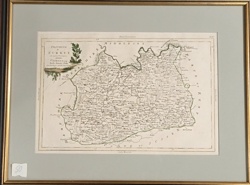
This is a mid-18th-century hand-colored copperplate engraved map titled 'Cow Cross Ward and Liberty and the Charter House', originally produced for the 1754-1755 edition of John Stow’s ‘A Survey of the Cities of London and Westminster’. The item is displayed in a landscape orientation, framed with a light-colored mat. The map features an ornate title cartouche in the upper center, a detailed key or 'Explanation' in the lower-right corner, and a compass rose at the bottom left. The layout depicts the Clerkenwell and Smithfield boundaries, including notable landmarks like the Charter House and its formal gardens. The hand-coloring uses a palette of muted greens for greenery, terrace-reds for building blocks, and yellow accents on the compass. Construction-wise, it appears to be on laid paper from the Georgian period. Regarding condition, there is visible age-toning and foxing across the surface, with a notable vertical fold line in the center corresponding to its original placement in a folio book. The ink remains sharp, indicating a good quality impression from the plate. A manufacturing inscription at the bottom indicates it was 'published according to Act of Parliament 1755 for Stow's Survey'. The level of detail in the street topography and the specialized key are indicators of high-quality mid-18th-century cartography.
AI Appraisal Report

·AI can make mistakes·Verify before acting
I have conducted a visual examination of the 1755 hand-colored engraving titled 'Cow Cross Ward and Liberty and the Charter House.' Based on the plate-mark characteristics, the presence of the vertical folio fold, and the specific typography of the title cartouche, the item is consistent with a genuine map from the 1754-1755 edition of John Stow’s ‘A Survey of the Cities of London and Westminster’, updated by John Strype. The hand-coloring appears to be professional and sympathetic to the Georgian era, though it is likely later than the 18th century. The condition shows moderate foxing and tanning consistent with laid paper of this period; however, the sharpness of the copperplate impression remains high, preserving the fine street-level topography. Market demand for Stow’s Survey maps remains stable, as they are essential documentation of pre-industrial London. This specific ward map is desirable due to its representation of the Charter House gardens and the Smithfield area. Comparable sales for framed maps of this size and period typically fall between $400 and $700 depending on the vibrancy of the coloring and the acidity level of the mounting materials. While the visual markers suggest authenticity, a definitive valuation is limited by the digital nature of this inspection. A full authentication would require removing the map from the frame to examine the 'chain lines' and watermark of the paper, and to check for acidic tape or mounting residues on the verso. Scientific testing of the pigment composition would be necessary to determine if the coloring is contemporary or a 19th/20th-century addition. Provenance documentation showing its removal from a specific folio volume would further solidify its value.

Get your items appraised

Instant estimates of your treasures with AI-powered appraisals

Browse More Appraisals