AI Appraisal Estimate

AI-generated estimates · not official valuations

From the user

What was submitted

Photo and notes provided by the user — not generated by AI

Submitted item photo
Submitted photo · June 13, 2026

User's notes

No additional notes provided.

AI analysis below

AI appraisal

AI analysis & estimate

AI-Generated · Verify before acting

Everything below is generated by AI for informational purposes only. AI can make mistakes — the AI may misidentify items or misattribute them (artist, maker, brand, designer, origin, era). This is not an official valuation and should not be used for insurance, sale, tax, estate, legal, or lending purposes — or any decision requiring a certified appraisal. It is not an authoritative claim about any person, brand, or rights holder — do not share or rely on it as a factual statement about a third party. Always consult qualified professionals before making financial decisions.

Read the full disclaimer

AI Identification

·Not independently authenticated·Verify before acting

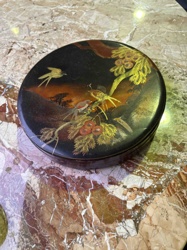
Japanese Black Lacquerware Vase with Maki-e Bird and Blossom Motif

Asian Decorative Arts - Lacquerware

AI Estimated Value

·Not an official valuation·Verify before acting

$450 - $650

As of June 13, 2026

AI Item Analysis

·AI can make mistakes·Verify before acting
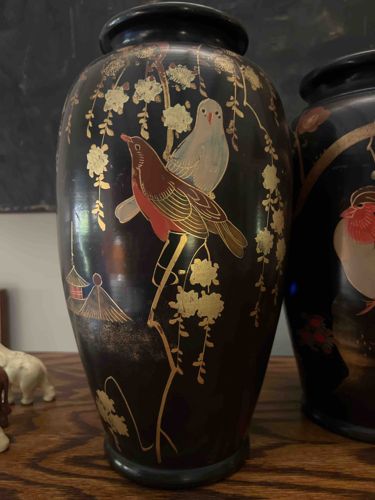
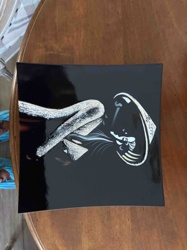
This is a large, ovoid-shaped Japanese lacquerware vase, likely constructed of a wood or composite base coated in multiple layers of polished black urushi lacquer. The decorative program features two birds perched on flowering cherry or plum branches, executed in the traditional maki-e (sprinkled gold powder) and polychrome lacquer technique. The primary bird in the foreground is rendered in a deep rust-red with intricate gold line-work detailing its feathers, while the background bird is a pale grey. The surrounding flora consists of gold-tone blossoms and weeping branches. In the lower-left background, a stylized architectural element resembling a pagoda or pavilion is visible in gold and red accents. The craftsmanship shows high-quality gilding with varied textures. The vase features a slightly flared rim and a matching circular foot. Regarding condition, the surface exhibits minor abrasions, surface scratches, and some dulling of the lacquer characteristic of age and domestic display. There are visible areas of wear on the gold leaf in the lower sections. The style and execution suggest a 20th-century production, possibly Showa era, intended for the decorative export or domestic gift market. No maker's marks are visible in this view, though they may be located on the base.
AI Appraisal Report

·AI can make mistakes·Verify before acting
I have conducted a visual examination of the Japanese Black Lacquerware Vase. The piece is a mid-20th century (Showa Era) production utilizing traditional Urushi and Maki-e techniques. The composition features a classic Kacho-ga (bird and flower) motif, with the red-bodied bird demonstrating a high degree of skill in the application of gold powder and 'tsunaki' line work. The ovoid form is balanced and typical of high-quality decorative wares from this period. Condition Assessment: The visual analysis reveals minor surface 'haze' and micro-scratches consistent with age. There is observable wear to the gold leaf on the lower quadrant and base rim, which is characteristic of handling and domestic display. The lack of visible 'crackle' or significant delamination suggests the wood core was well-seasoned, though stability cannot be fully confirmed without physical touch. Market Analysis: The market for Showa-era lacquerware remains stable but selective. Comparable pieces of this scale and decorative complexity typically realize mid-range prices at boutique auctions. While not a rare museum-quality antique from the Edo or Meiji periods, its aesthetic appeal maintains a steady demand within the interior design and Asian art collector markets. Limitations: This appraisal is based solely on high-resolution imagery. A physical inspection is required to verify the 'feel' of the lacquer—ensuring it is genuine Urushi rather than synthetic resin—and to examine the weight for core material identification. The absence of a visible 'signature' or 'hanko' on the base suggests a high-end workshop production rather than an individual master artist. Provenance documentation or a verified maker's box (tomobako) would be necessary to elevate the valuation toward the upper tier.

Get your items appraised

Instant estimates of your treasures with AI-powered appraisals

Browse More Appraisals