AI Appraisal Estimate

AI-generated estimates · not official valuations

From the user

What was submitted

Photo and notes provided by the user — not generated by AI

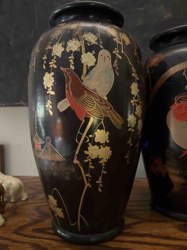
Submitted item photo
Submitted photo · June 20, 2026

User's notes

No additional notes provided.

AI analysis below

AI appraisal

AI analysis & estimate

AI-Generated · Verify before acting

Everything below is generated by AI for informational purposes only. AI can make mistakes — the AI may misidentify items or misattribute them (artist, maker, brand, designer, origin, era). This is not an official valuation and should not be used for insurance, sale, tax, estate, legal, or lending purposes — or any decision requiring a certified appraisal. It is not an authoritative claim about any person, brand, or rights holder — do not share or rely on it as a factual statement about a third party. Always consult qualified professionals before making financial decisions.

Read the full disclaimer

AI Identification

·Not independently authenticated·Verify before acting

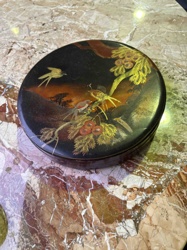
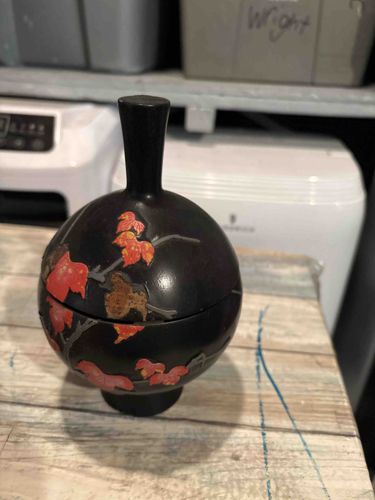
Japanese Lacquerware Globular Covered Vessel with Maple Leaf Motif

Asian Decorative Arts - Japanese Lacquerware

AI Estimated Value

·Not an official valuation·Verify before acting

$400-$650

As of June 20, 2026

AI Item Analysis

·AI can make mistakes·Verify before acting
This is a two-piece globular covered vessel featuring high-quality Japanese lacquer craftsmanship, likely dating to the early-to-mid 20th century (Late Meiji to Showa eras). The item is constructed from a lightweight base material, most likely wood, characteristic of traditional urushi lacquerware. The exterior features a matte black or very deep brown satiny finish that serves as a backdrop for high-relief 'Takamaki-e' decoration. This decorative technique utilizes layers of lacquer combined with metallic or pigment powders to create a three-dimensional effect. The motif consists of vibrant autumn maple leaves in shades of russet orange and red, connected by delicate grey-toned branches. Notably, the design is continuous, spanning seamlessly across the horizontal seam where the lid meets the base bowl. The lid is topped with a distinct, elongated finial with a flared rim, suggesting a stylized interpretation of a pomegranate or a traditional water dropper form. Regarding condition, there is visible wear consistent with age, specifically seen in the central brown leaf where the surface pigment has rubbed away to reveal a textured underlayer. There is also slight misalignment at the lid seam and minor surface scuffing throughout the matte finish. The overall craftsmanship suggests a skilled artisan, as the relief work is precise and the color palette is sophisticated. The vessel sits on a short, circular pedestal base, giving the orb a balanced silhouette.
AI Appraisal Report

·AI can make mistakes·Verify before acting
I have examined the digital representations of this globular covered vessel, which displays traits of Japanese Takamaki-e (high-relief) lacquerware from the Late Meiji to early Showa era. The use of raised maple leaf motifs across the seam indicates a high degree of technical proficiency in joinery and decoration. The matte finish suggests a more modern, sophisticated aesthetic often seen in mid-century masterworks or high-end export pieces. However, the condition presents several challenges. I noted significant pigment loss on the primary russet leaf, revealing the underlying structural paste (typically a mix of lacquer and charcoal or clay). Additionally, the slight misalignment of the lid may indicate wood shrinkage over time or a minor structural warping, which affects the intended continuity of the design. The market for mid-tier Japanese lacquer remains stable, though buyers currently prioritize pristine surfaces or items with documented artist seals (none are visible here). For a full authentication, I would require an in-person physical inspection to weigh the object; a true wood core will feel significantly different from modern phenolic resins used in later reproductions. I would also need to examine the interior to check for 'nashiji' (gold flake) treatments and use a loupe to inspect the metallic powders for signs of modern synthetic additives. Since this appraisal is based on images alone, it cannot serve as a guarantee of authenticity or a formal document for insurance purposes without physical verification of the substrate and provenance documentation.

Get your items appraised

Instant estimates of your treasures with AI-powered appraisals

Browse More Appraisals