AI Appraisal Estimate

AI-generated estimates · not official valuations

From the user

What was submitted

Photo and notes provided by the user — not generated by AI

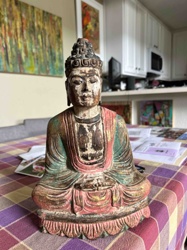
Submitted item photo
Submitted photo · June 10, 2026

User's notes

No additional notes provided.

AI analysis below

AI appraisal

AI analysis & estimate

AI-Generated · Verify before acting

Everything below is generated by AI for informational purposes only. AI can make mistakes — the AI may misidentify items or misattribute them (artist, maker, brand, designer, origin, era). This is not an official valuation and should not be used for insurance, sale, tax, estate, legal, or lending purposes — or any decision requiring a certified appraisal. It is not an authoritative claim about any person, brand, or rights holder — do not share or rely on it as a factual statement about a third party. Always consult qualified professionals before making financial decisions.

Read the full disclaimer

AI Identification

·Not independently authenticated·Verify before acting

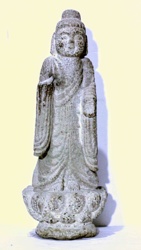
Seated Shakyamuni Buddha Bronze Statue

Asian Art & Religious Artifacts

AI Estimated Value

·Not an official valuation·Verify before acting

$400-$600

As of June 10, 2026

AI Item Analysis

·AI can make mistakes·Verify before acting
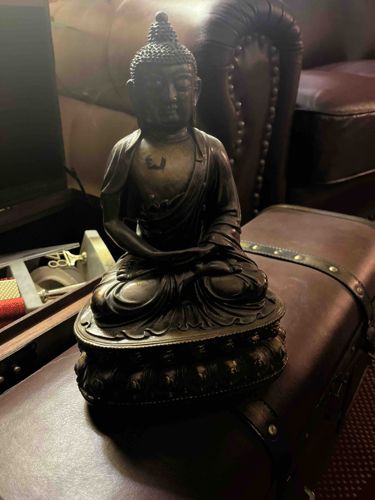
This is a cast metal statue, likely bronze or a similar heavy copper alloy, depicting the Shakyamuni Buddha in a meditative seated posture (Dhyana Asana) on a double-tiered lotus base. The figure stands approximately 10 to 12 inches tall and displays a dark, aged patina with areas of lighter metallic oxidation. The Buddha is portrayed with the traditional 'ushnisha' (crowned topknot) consisting of tight snail-shell curls, elongated earlobes signifying wisdom, and eyes closed in meditation. He wears a simple monastic robe draped over the left shoulder, leaving the right chest partially exposed; a notable marking or symbol is visible on the upper left chest area, possibly representing a simplified swastika or sectarian mark. The hands are folded in the lap in the 'Dhyana Mudra' of meditation. The craftsmanship shows moderate detail in the drapery folds and the lotus petals of the base. Conditioning issues include surface dust accumulation, minor pitting consistent with age, and some irregularities in the metal finish. While no maker's mark is visible from this angle, the style resembles late 19th or early 20th-century East Asian decorative export pieces rather than an ancient temple relic. The tiered lotus base features a scalloped edge and beaded detailing, indicating a standard level of industrial-age craftsmanship.
AI Appraisal Report

·AI can make mistakes·Verify before acting
Based on my visual examination of this Seated Shakyamuni Buddha Bronze Statue, I have identified it as a late 19th-century to early 20th-century decorative cast copper alloy figure, likely of Chinese or Southeast Asian origin. The 10-12 inch stature and the dark, chemically induced patina suggest it was intended for the export or burgeoning tourist market rather than as a consecrated temple relic. The presence of the 'wan' symbol (swastika) on the chest and the Dhyana Mudra are standard iconography. The condition is fair to good; while the metal shows pitting and surface irregularities, these are consistent with industrial-age casting techniques rather than ancient hand-modeling. Market demand for early 20th-century Buddhist bronzes remains steady, though values are capped by the lack of a period reign mark (such as Ming or Qing dynasty marks). Similar pieces frequently appear at auction with realized prices in the mid-hundreds. A major factor limiting value is the lack of refined detail in the hair curls and lotus base, which suggests mass-production. This appraisal is limited by the digital nature of the inspection. To fully authenticate the age and origin, I would need to examine the 'core' material inside the statue, perform a chemical analysis of the alloy, and inspect the underside for traditional sealing or consecration marks (such as a copper plate with a vajra). Provenance documentation would also be required to ensure compliance with cultural heritage import/export regulations. Without physical inspection, I cannot rule out a modern 20th-century reproduction designed to simulate age.

Related Tags

Explore similar items and categories

Get your items appraised

Instant estimates of your treasures with AI-powered appraisals

Browse More Appraisals