These notes were written by the person who submitted this item. Appraiser.AI has not verified them, and the AI's identification and estimate may rely on them.
AI Estimated Value
Not an official valuation
$450 - $650
AI estimate as of October 13, 2025 · verify with a professional before acting
AI-Generated · Verify before acting
Everything on this page is generated by AI for informational purposes only. AI can make mistakes — the AI may misidentify items or misattribute them (artist, maker, brand, designer, origin, era). This is not an official valuation and should not be used for insurance, sale, tax, estate, legal, or lending purposes — or any decision requiring a certified appraisal. It is not an authoritative claim about any person, brand, or rights holder — do not share or rely on it as a factual statement about a third party. Always consult qualified professionals before making financial decisions.
This analysis also relies on unverified notes provided by the user, which may be incomplete or inaccurate and could affect the result.
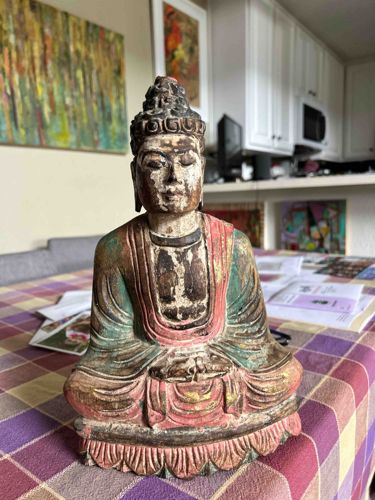
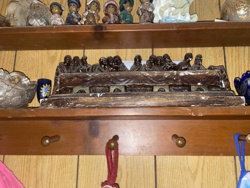
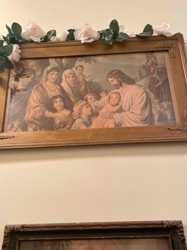
This item is a seated Buddha statue, hand-carved from wood, displaying significant age and patina. The Buddha is depicted in the Dhyana Mudra, with hands resting in the lap, palms upward, indicating meditation and contemplation. The overall color palette is muted and distressed, featuring remnants of original polychrome paint in shades of white, pale green (teal), red (faded terracotta or rose), and dark brown/black. The face shows considerable paint loss, revealing the underlying dark wood, particularly around the cheeks, forehead, and nose. The ushnisha, the cranial bump symbolizing wisdom, is prominent and has a stacked, ornate appearance, primarily in dark brown/black with some lighter patches of wear. The robes are draped loosely, with visible folds and contours carved into the wood. The chest area also shows significant paint loss, exposing the raw wood. The base features a lotus pedestal design, carved with repetitive, overlapping petal motifs, predominantly in faded red and dark wood. The craftsmanship suggests a traditional, possibly folk art style, with slightly simplified features but still conveying a serene expression. There are clear signs of wear and age, including extensive paint chipping, surface abrasions, and a generally weathered appearance across the entire piece. The wood itself appears somewhat aged and possibly porous, contributing to the distressed aesthetic. No specific maker's marks or signatures are visible in the provided images. Given the style and condition, it likely dates from the early to mid-20th century or possibly earlier, exhibiting characteristics of Southeast or East Asian spiritual art.
AI Appraisal Report
Upon examination of the Asian Patinated Wooden Buddha Statue, I assess it to be a compelling example of traditional religious folk art, likely originating from Southeast or East Asia and dating to the early to mid-20th century. The hand-carved piece depicts the Buddha in Dhyana Mudra (meditation pose) atop a lotus pedestal. The statue exhibits a significant, and in my view authentic, patina developed over time. The extensive loss of the original polychrome paint, revealing the dark wood beneath, is consistent with natural ageing and environmental exposure rather than artificial distress. This weathered condition, while impacting its pristine state, contributes to its historical and aesthetic character.
The market for such decorative religious artifacts is stable, with comparable pieces of similar age, size, and condition typically selling in the $400 to $700 range at auction and in galleries. The primary factor limiting the value is its likely 20th-century origin and folk art quality, which makes it more accessible than older, finer, or Imperial-commissioned works. The lack of identifiable maker's marks or provenance also anchors its value in the decorative and spiritual art category rather than as a fine art antique.
It is crucial to note that this appraisal is based solely on photographic evidence. A definitive authentication and more precise dating would require in-person examination to assess the wood type, tool marks, and any hidden inscriptions. Scientific analysis, such as radiocarbon dating of the wood, would be necessary to confirm an age earlier than the 20th century, which could significantly increase its value.