AI estimate as of December 2, 2025 · verify with a professional before acting
AI-Generated · Verify before acting
Everything on this page is generated by AI for informational purposes only. AI can make mistakes — the AI may misidentify items or misattribute them (artist, maker, brand, designer, origin, era). This is not an official valuation and should not be used for insurance, sale, tax, estate, legal, or lending purposes — or any decision requiring a certified appraisal. It is not an authoritative claim about any person, brand, or rights holder — do not share or rely on it as a factual statement about a third party. Always consult qualified professionals before making financial decisions.
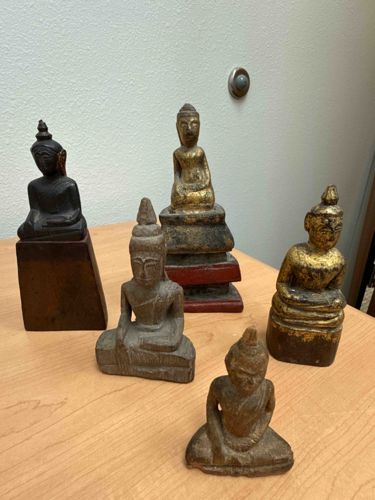
This collection comprises five small-scale, seated figures, primarily depicting Buddha or revered monks, likely originating from Southeast Asia, specifically Thailand or Myanmar, given their stylistic characteristics. The figures vary in material, condition, and finish, suggesting they may have been acquired individually rather than as a single set. The tallest figure, positioned at the back left, is made of dark wood, possibly ebony or a similarly dense hardwood, and features a subtle lean to the head. It is adhered to a rectangular, dark brown wooden base. The figure to its right is a gilded Buddha in a sitting posture, resting on a multi-tiered, possibly lacquered wood or stucco base with visible red pigment under the gilding, indicating a layered construction and possibly age. Another seated figure, in the center foreground, is carved from a lighter-colored wood or possibly a resin composite with an aged, gray-brown patina, and features an elongated, tapered ushnisha. To the right, a heavily gilded figure with significant loss to the gilding, revealing a dark underlayer, also sits on a smaller, possibly wooden base that appears to be integrated into the figure's form. The smallest figure in the front right appears to be carved from a single piece of wood, exhibiting a rustic, weathered finish and possibly depicting a monk rather than the Buddha, identifiable by simpler robes and headwear. Overall, the items exhibit varying degrees of wear, including chipping, flaking gilding, surface abrasions, and a general antique patina consistent with their age and potential use in homes or shrines. No clear maker's marks or signatures are immediately visible from the images. The quality of craftsmanship ranges from modestly carved to more finely detailed, with some pieces showing a greater degree of artistic refinement in their facial features and drapery.
AI Appraisal Report
Based on my visual examination of the provided image, this collection of five Southeast Asian Buddha and Monk statues presents as an interesting grouping of devotional items, likely from Thailand or Myanmar. The varied materials—dark wood, gilded stucco/wood, lighter wood/resin—and different styles suggest they were acquired individually. The condition varies significantly; some pieces show charming patination and wear consistent with age, such as the flaking gilding on two figures and the rustic finish on the smallest wooden monk. This wear generally enhances their antique appeal rather than detracting from their value, as it testifies to their history and use. Craftsmanship ranges from folk art simplicity to more refined detail, particularly noticeable in the gilded Buddha. Authenticity, based solely on imagery, appears robust for regional origin and age, likely 20th century or earlier regional craft. These types of figures, while generally not exceedingly rare, maintain a steady market demand among collectors of Asian art and religious artifacts. Their smaller scale and decorative appeal contribute positively to their marketability. However, the lack of definitive provenance, coupled with their being unsigned, limits the potential for higher values. For a more conclusive authenticity verification, an in-person examination would be crucial to assess wood types, construction methods, and gilding layers. Scientific testing, such as carbon dating for organic materials or analysis of pigments, would be necessary to pinpoint exact age and rule out more modern reproductions definitively.