AI estimate as of July 8, 2025 · verify with a professional before acting
AI-Generated · Verify before acting
Everything on this page is generated by AI for informational purposes only. AI can make mistakes — the AI may misidentify items or misattribute them (artist, maker, brand, designer, origin, era). This is not an official valuation and should not be used for insurance, sale, tax, estate, legal, or lending purposes — or any decision requiring a certified appraisal. It is not an authoritative claim about any person, brand, or rights holder — do not share or rely on it as a factual statement about a third party. Always consult qualified professionals before making financial decisions.
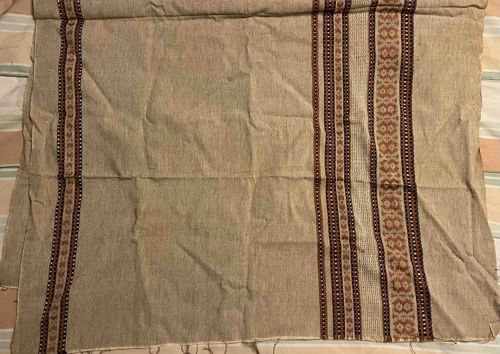
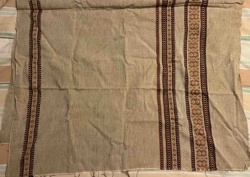
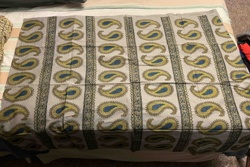
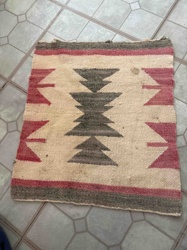
This appears to be a handwoven textile, possibly a runner, shawl, or blanket, characterized by its natural, undyed, earthy tone of beige or light brown. The material seems to be a natural fiber, possibly wool, cotton, or a blend, with a visibly textured weave that suggests a rustic or artisanal production method. The overall condition shows some creasing and folds, which are consistent with typical use or storage, but no obvious tears or significant damage. There are some loose threads visible along the bottom edge, indicating an unfinished or fringed border. The fabric exhibits a somewhat coarse texture, giving it a tactile, durable appearance. The most prominent features are the decorative woven bands running lengthwise. On the right side, there are multiple vertical stripes in differing widths, creating a visually appealing pattern. The central wide stripe features an intricate geometric or floral motif repeating along its length, executed in shades of darker brown, possibly achieved through different colored threads or natural dyes. This patterned band is flanked by narrower stripes of solid dark brown, and very thin lines of what appears to be a contrasting lighter shade within the dark brown bands, possibly a subtle white or light brown speckle. On the left side, there is a single, narrower decorative band that mirrors the striped elements of the wider band, also in dark brown with subtle lighter accents. The patterns suggest a traditional or ethnic design, hinting at a specific cultural origin. The craftsmanship appears to be handloom work, given the slight irregularities and the characteristic feel of handmade textiles. The style points to a vintage or antique piece due to the traditional weaving techniques and patterns, likely from the early to mid-20th century or earlier, depending on the specific cultural context.
AI Appraisal Report
Upon my virtual examination of this Handwoven Striped Textile, it presents as a natural fiber piece, likely wool or cotton, characterized by an earthy beige base and striking woven bands. The overall condition appears good; creases and folds are present, which are normal for textile handling and storage, but I see no obvious tears or significant damage. The loose threads at the bottom edge suggest an unfinished or fringed border, typical of handwoven items. The detailed geometric or floral motifs within the central band, flanked by narrower dark brown stripes with subtle lighter accents, indicate a traditional and possibly culturally specific design. This suggests authenticity as a genuine handwoven piece, given the visible irregularities inherent to handloom work.
However, limitations exist with image-based appraisal. Without physical inspection, I cannot confirm the exact fiber composition, the precise weaving technique, or the age definitively. True authenticity verification would require in-person examination to assess weave density, dye analysis for natural vs. synthetic origins, and microscopic fiber analysis. Provenance documentation, such as collection history or maker's marks, would significantly aid in pinpointing cultural origin and age, which are crucial for valuation.
Market conditions for vintage and antique ethnic textiles are generally stable, with demand driven by collectors and interior designers seeking unique, artisanal pieces. Comparables would include other tribal or folk art textiles from regions known for such weaving, such as Native American, Mexican, or Middle Eastern textiles, depending on the as-yet-undetermined origin. The uniqueness of the pattern and the apparent good condition contribute to its appeal. Rarity can only be assessed with a confirmed origin and understanding of the specific weaving community. Factors that would significantly impact value include the actual age (true antique vs. vintage), the specific cultural origin and its associated market, and the confirmed fiber type (e.g., fine wool vs. common cotton). Given these factors, particularly the undeterminable origin and age without further testing, the value must remain a range.