AI estimate as of August 14, 2025 · verify with a professional before acting
AI-Generated · Verify before acting
Everything on this page is generated by AI for informational purposes only. AI can make mistakes — the AI may misidentify items or misattribute them (artist, maker, brand, designer, origin, era). This is not an official valuation and should not be used for insurance, sale, tax, estate, legal, or lending purposes — or any decision requiring a certified appraisal. It is not an authoritative claim about any person, brand, or rights holder — do not share or rely on it as a factual statement about a third party. Always consult qualified professionals before making financial decisions.
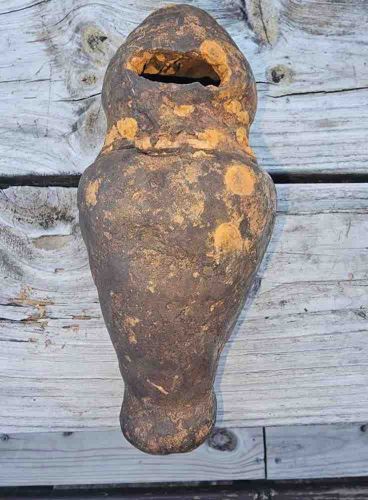
This appears to be an ancient or tribal ovoid-shaped pottery vessel or effigy, possibly anthropomorphic or zoomorphic due to the distinct opening at what seems to be the top, resembling a mouth or eye socket. The item is characterized by its uneven, mottled surface, primarily dark brown or black with significant patches and speckles of a bright orange to reddish-brown coloration, suggesting a natural clay body with mineral deposits or possibly a painted finish that has weathered over time. The material appears to be unglazed, coarse earthenware or terracotta, showcasing a robust and primitive construction. The form is bulbous in the mid-section, tapering towards a narrower base and an upwardly pointed, somewhat flattened top. The opening at the top is irregular and roughly oval, indicating a hand-formed or rustic manufacturing process. There are no discernible maker's marks, signatures, or specific decorative patterns beyond the natural texture and discoloration. The overall condition suggests considerable age and exposure, with a weathered patina, minor pitting, and erosion of the surface. Its organic shape and rudimentary craftsmanship point to a hand-built method, possibly coiled or pinched. The bright orange spots could be iron oxide bleed-through, a distinct type of clay, or a residue from its use or burial. The item possesses a strong visible patina indicative of significant age, making an estimated age difficult without further testing, but it strongly suggests pre-industrial or ancient origins. Its unique and somewhat abstract form distinguishes it as a piece of ethnographic or archaeological interest, reflecting a particular cultural aesthetic or utilitarian purpose that is not immediately obvious.
AI Appraisal Report
I have carefully examined the provided image of this ovoid terracotta vessel/effigy. Based on visual assessment alone, the item presents compelling indicators of significant age and hand-built, pre-industrial craftsmanship. The uneven, mottled surface, primarily dark with striking orange-red patches, strongly suggests natural weathering, mineral deposits, or iron oxide bleed-through characteristic of ancient earthenware. The unglazed, coarse texture and irregular opening indicate a rudimentary, possibly coiled or pinched, construction method.
From the image, the condition appears consistent with considerable age and exposure, displaying a strong patina, minor pitting, and surface erosion, which are expected and desirable for such an antiquity. Authenticity, based solely on visual cues, points towards a genuine ancient artifact. However, definitive authentication requires physical inspection to verify surface texture, assess weight, and conduct scientific testing (e.g., thermoluminescence for dating clay) to confirm age and origin. Provenance documentation, if available, would significantly enhance authenticity.
Regarding market conditions, similar ethnographic or archaeological terracotta pieces vary widely in value based on verifiable age, cultural attribution, rarity, and aesthetic appeal. Given its abstract and somewhat ambiguous form, its demand lies within niche art and antiquities markets, particularly collectors interested in primitive art or archaeological finds. Its rarity is difficult to ascertain without knowing its precise origin, but unique hand-built pieces always hold a degree of rarity. The distinct opening, suggestive of an effigy, could enhance its appeal.
Factors significantly impacting value include verifiable age, specific cultural attribution, and whether it represents a functional vessel or an effigy. Without physical examination and scientific dating, these remain speculative. My appraisal is limited by the lack of physical access and provenance, preventing conclusive authentication and precise dating. For full verification, in-person examination by an expert, along with potential scientific analysis, is essential.