AI Appraisal Estimate

AI-generated estimates · not official valuations

From the user

What was submitted

Photo and notes provided by the user — not generated by AI

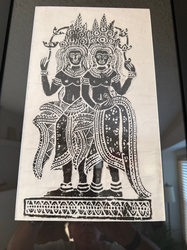
Submitted item photo
Submitted photo · June 4, 2026

User's notes

No additional notes provided.

AI analysis below

AI appraisal

AI analysis & estimate

AI-Generated · Verify before acting

Everything below is generated by AI for informational purposes only. AI can make mistakes — the AI may misidentify items or misattribute them (artist, maker, brand, designer, origin, era). This is not an official valuation and should not be used for insurance, sale, tax, estate, legal, or lending purposes — or any decision requiring a certified appraisal. It is not an authoritative claim about any person, brand, or rights holder — do not share or rely on it as a factual statement about a third party. Always consult qualified professionals before making financial decisions.

Read the full disclaimer

AI Identification

·Not independently authenticated·Verify before acting

Framed Thai Temple Manuscript Painting on Cloth or Bark Paper

Fine Art / Asian Antiquities

AI Estimated Value

·Not an official valuation·Verify before acting

$450 - $700

As of June 4, 2026

AI Item Analysis

·AI can make mistakes·Verify before acting
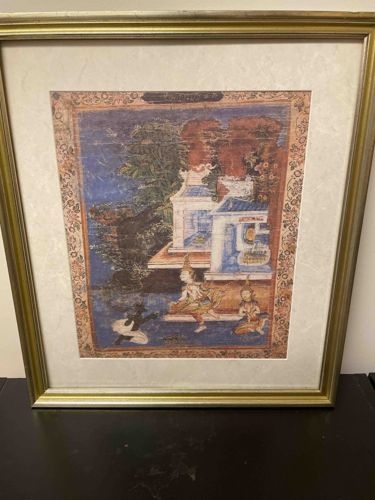
This item is a framed Southeast Asian narrative painting, likely originating from Thailand. The artwork depicts a traditional mythological or religious scene, possibly a Jataka tale, featuring figures in ornate traditional attire, including pointed headdresses characteristic of Thai Buddhist iconography. The scene includes architectural structures and stylized foliage set against a vibrant blue and orange-hued background. The central composition is enclosed within a decorative floral border. Physically, the piece appears to be executed on a textured substrate such as hand-woven cloth or traditional bark paper, which shows significant signs of age. Notable condition issues include horizontal creasing, areas of pigment loss, and surface abrasions throughout the image, consistent with 19th or early 20th-century origins. The painting is professionally matted in an off-white textured mat and housed in a modern gold-toned metal frame with glass protection. The craftsmanship indicates a skilled hand, typical of temple mural studies or vernacular religious art. Patina is evident in the darkening of the substrate and the softening of the vegetable-based dyes or mineral pigments used. No signatures are visible, which is common for such communal religious works.
AI Appraisal Report

·AI can make mistakes·Verify before acting
I have carefully examined the provided images of this Southeast Asian narrative painting. Based on the stylistic execution, iconography, and physical characteristics of the substrate, I have identified this as a late 19th to early 20th-century Thai 'Phra Malai' or Jataka tale illustration. The use of mineral pigments on what appears to be hand-woven cotton or Khoi (bark) paper is consistent with traditional Thai temple arts. The figures exhibit the 'Kranok' style of ornamentation, and the heavy creasing suggests it was originally part of a folding manuscript or a larger religious hanging. The condition is fair; while the age-related darkening and pigment loss lend an antique patina, the horizontal creases and abrasions represent significant structural wear that slightly limits the value. The modern framing provides stability but does not add to the historical value. The market for Thai religious art remains steady, though values for anonymous 19th-century works have softened compared to the peak of the 1990s. Comparable sales of similar-sized manuscript fragments in North American auctions typically fall within the $400 to $800 range. Notably, the lack of a provenance history (social or institutional) prevents a higher valuation. This appraisal is based solely on visual inspection of digital images. A definitive authentication would require an in-person examination to verify the fiber composition of the substrate, chemical analysis of the pigments to rule out modern synthetic dyes, and an inspection behind the matting to assess the full extent of the paper's integrity. Documentation of its legal export or acquisition prior to international cultural property agreements would also be necessary to achieve the higher end of the market spectrum.

Get your items appraised

Instant estimates of your treasures with AI-powered appraisals

Browse More Appraisals