AI Appraisal Estimate

AI-generated estimates · not official valuations

From the user

What was submitted

Photo and notes provided by the user — not generated by AI

Submitted item photo
Submitted photo · June 6, 2026

User's notes

No additional notes provided.

AI analysis below

AI appraisal

AI analysis & estimate

AI-Generated · Verify before acting

Everything below is generated by AI for informational purposes only. AI can make mistakes — the AI may misidentify items or misattribute them (artist, maker, brand, designer, origin, era). This is not an official valuation and should not be used for insurance, sale, tax, estate, legal, or lending purposes — or any decision requiring a certified appraisal. It is not an authoritative claim about any person, brand, or rights holder — do not share or rely on it as a factual statement about a third party. Always consult qualified professionals before making financial decisions.

Read the full disclaimer

AI Identification

·Not independently authenticated·Verify before acting

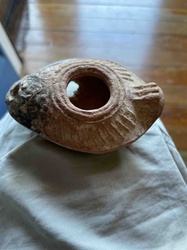
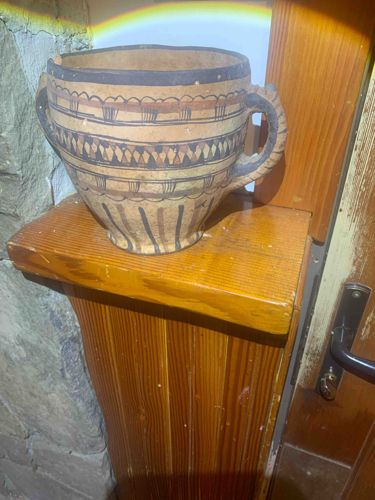
Geometric Style Polychrome Terracotta Krateriskos

Art and Antiquities - Ceramics

AI Estimated Value

·Not an official valuation·Verify before acting

$150-$300

As of June 6, 2026

AI Item Analysis

·AI can make mistakes·Verify before acting
This is a hand-formed earthenware ceramic vessel, specifically a small two-handled krater or krateriskos, echoing the Archaic or Geometric Greek style. The item is constructed from a coarse-textured buff or light-tan clay with two vertical loop handles attached to the shoulder and rim. Its decorative scheme consists of horizontal bands of polychrome slip in matte black and reddish-brown. Key motifs include a row of repeating scallops or arches near the rim, a central band featuring a double-triangle or 'butterfly' geometric pattern, and vertical striped groups extending toward the foot. The base is a simple flared pedestal. Regarding condition, the piece shows significant evidence of aging and handling, including numerous surface chips around the rim and base, substantial fading, and abrasions to the painted pigments. There appears to be a heavy accumulation of dust and surface grime consistent with long-term open storage. The irregular, slightly asymmetrical shape suggests handmade construction rather than precision wheel-turning. While it mimics ancient Mediterranean aesthetics, the overall clay texture and pigment application may suggest a 19th or early 20th-century grand tour souvenir or a localized folk-art production.

AI Appraisal Report

·AI can make mistakes·Verify before acting
Upon visual examination of this polychrome terracotta krateriskos, I have determined the piece is a decorative revival work, likely dating to the late 19th or early 20th century. While it successfully captures the spirit of Geometric Greek ceramics through its double-triangle motifs and horizontal banding, several physical characteristics suggest a more modern origin. The clay body exhibits a specific coarseness and 'pitted' texture that deviates from the refined levigated clays typical of authentic Archaic vessels. Furthermore, the pigment wear appears to be surface-level abrasion rather than the deep mineralization expected from centuries of burial. The condition is fair to good; while the surface grime and rim chips lend an air of antiquity, they primarily represent a lack of conservation rather than archaeological provenance. The market for 'Grand Tour' souvenirs and high-quality folk-art replicas is stable, though significantly lower than the market for authenticated antiquities. Comparable items sold at specialty estate auctions typically fetch between $100 and $400 depending on the buyer's interest in the aesthetic over historical significance. The primary factor limiting the value is the lack of verifiable provenance and the stylistic inconsistencies with known Attic or Cycladic originals. Please note that this appraisal is based on photographic evidence. A definitive determination of age would require a physical inspection to check for modern tool marks and, ideally, Thermoluminescence (TL) testing to establish the last firing date of the clay. Without such scientific verification or a documented collection history (provenance) pre-dating 1970, the item must be valued as a decorative reproduction.

Get your items appraised

Instant estimates of your treasures with AI-powered appraisals

Browse More Appraisals