AI Appraisal Estimate

AI-generated estimates · not official valuations

From the user

What was submitted

Photo and notes provided by the user — not generated by AI

Submitted item photo
Submitted photo · June 26, 2026

User's notes

No additional notes provided.

AI analysis below

AI appraisal

AI analysis & estimate

AI-Generated · Verify before acting

Everything below is generated by AI for informational purposes only. AI can make mistakes — the AI may misidentify items or misattribute them (artist, maker, brand, designer, origin, era). This is not an official valuation and should not be used for insurance, sale, tax, estate, legal, or lending purposes — or any decision requiring a certified appraisal. It is not an authoritative claim about any person, brand, or rights holder — do not share or rely on it as a factual statement about a third party. Always consult qualified professionals before making financial decisions.

Read the full disclaimer

AI Identification

·Not independently authenticated·Verify before acting

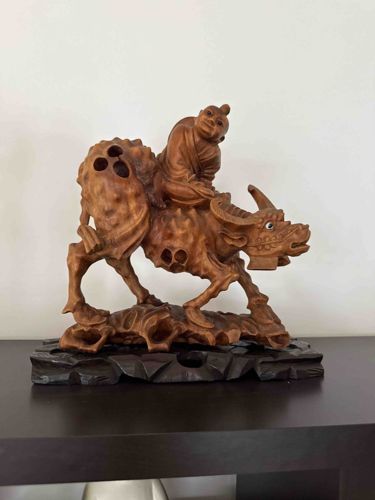
Carved Boxwood Figural Sculpture of a Boy Riding a Water Buffalo

Asian Art & Antiques

AI Estimated Value

·Not an official valuation·Verify before acting

$1,200 - $1,800 USD

As of June 26, 2026

AI Item Analysis

·AI can make mistakes·Verify before acting
This is a detailed hand-carved sculpture depicting a young boy or shepherd seated atop a water buffalo, a classic motif in Chinese folk art and Taoist philosophy representing harmony with nature. Carved from boxwood (huangyangmu), the piece exhibits a warm, honey-toned honey-brown patina with a smooth, semi-glossy finish. The buffalo is rendered with an intentionally gnarled or 'root-like' texture, particularly on its rear and flanks, featuring hollowed-out apertures that mimic natural burl formations. The animal features large, curved horns and inset white eyes (possibly bone or glass) providing a vivid expression. The human figure is expertly detailed with flowing robes and a serene facial expression. The entire sculpture is mounted on a separate, darker-stained wooden base with pierced, openwork carving to resemble jagged rockwork or stylized roots. The craftsmanship is of high quality, evidenced by the fluid lines of the drapery and the intricate management of the wood's density. No visible signatures or maker's marks are apparent in the primary view. The condition appears excellent with no major cracks or repairs visible, though a natural aged patina and minor dust accumulation in the crevices are present. Stylistically, this piece reflects late 19th-century to mid-20th-century artisanal traditions.
AI Appraisal Report

·AI can make mistakes·Verify before acting
I have examined the digital representations of this carved boxwood sculpture. The piece exhibits characteristic traits of late Qing Dynasty to early Republic period (circa 1890–1940) craftsmanship. The use of 'huangyangmu' (boxwood) is ideal for this scale, as its dense grain allows for the high-relief carving seen in the boy’s robes and the buffalo’s expressive features. The 'root-style' treatment of the buffalo’s body adds significant aesthetic value, blending traditional figural carving with the scholar’s rock aesthetic. The condition appears excellent with a well-developed, authentic honey-colored patina, though I note the typical micro-abrasions consistent with age. Market demand for Chinese boxwood carvings remains steady, particularly for iconic Taoist motifs like the 'Oxherder Boy,' which symbolizes the taming of the mind. Comparables for boxwood carvings of this size and quality typically hammer between $1,000 and $2,500 at specialized Asian art auctions. The inclusion of the original openwork base and the presence of inset eyes (likely bone) elevate its value above more modern, mass-produced replicas. Limitations: This appraisal is based solely on visual inspection of images. Full authentication requires an in-person examination to verify the depth of the patina and to ensure the 'root' apertures are hand-carved rather than chemically aged. Proof of provenance—such as an original bill of sale or exhibition history—would be required to push the valuation toward the top of the market. Scientific testing via UV light would also be necessary to rule out modern synthetic resins or concealed repairs that are not visible in high-resolution photography.

Get your items appraised

Instant estimates of your treasures with AI-powered appraisals

Browse More Appraisals