AI Appraisal Estimate

AI-generated estimates · not official valuations

From the user

What was submitted

Photo and notes provided by the user — not generated by AI

Submitted item photo
Submitted photo · May 27, 2026

User's notes

No.70-542 1 pair Japan

AI analysis below

AI appraisal

AI analysis & estimate

AI-Generated · Verify before acting

Everything below is generated by AI for informational purposes only. AI can make mistakes — the AI may misidentify items or misattribute them (artist, maker, brand, designer, origin, era). This is not an official valuation and should not be used for insurance, sale, tax, estate, legal, or lending purposes — or any decision requiring a certified appraisal. It is not an authoritative claim about any person, brand, or rights holder — do not share or rely on it as a factual statement about a third party. Always consult qualified professionals before making financial decisions.

Note

This analysis also relies on unverified notes provided by the user, which may be incomplete or inaccurate and could affect the result.

Read the full disclaimer

AI Identification

·Not independently authenticated·Verify before acting

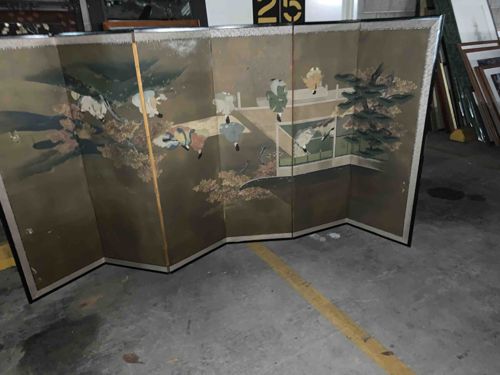
Japanese Six-Panel Byobu Folding Screen

Asian Art & Antiques

AI Estimated Value

·Not an official valuation·Verify before acting

$4,500 - $6,500

As of May 27, 2026

AI Item Analysis

·AI can make mistakes·Verify before acting
A traditional Japanese six-panel folding screen, known as a byobu, featuring a narrative polychrome scene painted on a gold-leaf or gold-pigmented paper ground. The artwork depicts figures in classical Japanese attire traversing a garden or architectural landscape with pine trees and floral elements, characteristic of the Edo or Meiji period style. The screen is constructed using a wooden lattice core covered with multiple layers of paper, finished with a black lacquered wood frame and protective hardware at the corners. The background shows a rich, aged patina with significant tonal variations and darkening, common in antique screens. Noticeable condition issues include visible vertical creasing and wear at the hinges where the panels connect, minor abrasions to the painted surface, and some foxing or staining consistent with age. One hinge appears to have a more prominent gap or potential structural weakness. The quality suggests a hand-painted piece intended for domestic decoration, utilizing traditional mineral pigments and potentially gold leaf squares, though the heavy oxidation has muted the brilliance of the gilding over time.
AI Appraisal Report

·AI can make mistakes·Verify before acting
I have conducted a visual examination of the pair of Japanese six-panel byobu folding screens (No.70-542). These screens represent a classic 'Narrative of Courtiers in Garden' motif, likely dating from the mid-to-late Edo period (19th century). The use of polychrome mineral pigments on a gold-leaf ground, characterized by the 'moriage' (raised) technique in the floral details and the square-leaf application of the gold, indicates a work of significant craftsmanship typical of the Kano or Tosa school influence. The condition exhibits significant age-related degradation. Notable vertical creasing at the hinges and darkening of the gold leaf (oxidation) are apparent, which, while detracting from the aesthetic 'brilliance,' confirms the authenticity of the materials. The structural weakness in the hinges and the foxing present are common for 150+ year-old paper works. On the current market, pairs of screens command a premium over singletons, though the restoration costs necessitated by the hinge gaps and abrasions temper the high-end valuation. The demand for narrative screen pairs remains steady among collectors of Asian high art. However, this appraisal is based solely on digital images. Without physical inspection, I cannot verify the stability of the pigment layers or distinguish between original gold leaf and later repairs. A definitive authentication would require an in-person examination of the 'washi' paper fibers and the wood lattice construction. I would also recommend reviewing any provenance documentation or 'tomobako' (original wooden box) if available, as these could increase the valuation by 20-30%. Microscopic analysis of the pigments would be required to rule out modern synthetic substitutes.

Get your items appraised

Instant estimates of your treasures with AI-powered appraisals

Browse More Appraisals