AI Appraisal Estimate

AI-generated estimates · not official valuations

From the user

What was submitted

Photo and notes provided by the user — not generated by AI

Submitted item photo
Submitted photo · June 18, 2026

User's notes

No additional notes provided.

AI analysis below

AI appraisal

AI analysis & estimate

AI-Generated · Verify before acting

Everything below is generated by AI for informational purposes only. AI can make mistakes — the AI may misidentify items or misattribute them (artist, maker, brand, designer, origin, era). This is not an official valuation and should not be used for insurance, sale, tax, estate, legal, or lending purposes — or any decision requiring a certified appraisal. It is not an authoritative claim about any person, brand, or rights holder — do not share or rely on it as a factual statement about a third party. Always consult qualified professionals before making financial decisions.

Read the full disclaimer

AI Identification

·Not independently authenticated·Verify before acting

Chinese Calligraphy and Peony Silk Painting

Asian Art & Antiques

AI Estimated Value

·Not an official valuation·Verify before acting

$40-$80

As of June 18, 2026

AI Item Analysis

·AI can make mistakes·Verify before acting
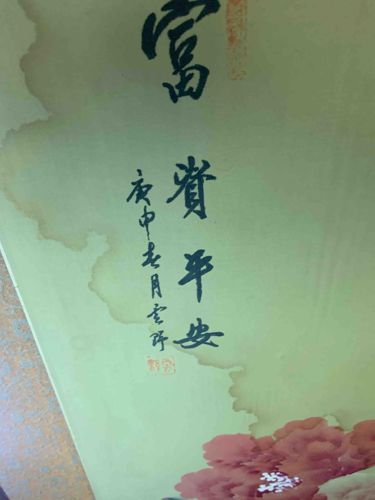
This item is a traditional Chinese vertical hanging scroll painting, executed on a pale green silk or treated paper ground. The artwork features bold, black ink calligraphy in Semi-cursive script (Xing-shu), prominently displaying the phrase 'Fu Gui Ping An' (Wealth, Honor, and Peace), a common auspicious greeting. Below the calligraphy is a partial view of a large, blossoming pink peony, a flower traditionally symbolizing prosperity and nobility in Chinese culture. The painting includes a vertical column of smaller script detailing the date and artist, accompanied by two vermilion seal stamps (yinxin) at the bottom and one at the top right, which are essential for authentication but currently faded. The construction shows a silk mounting border with a metallic gold fleck pattern. Regarding condition, the piece shows significant and severe water damage, characterized by large, amber-colored tide lines and blooming stains that crawl across the left side of the composition. This suggests a history of improper storage or exposure to moisture, which has compromised the substrate's integrity. The style suggests a mid-to-late 20th-century production, likely intended for decorative or celebratory home display. While the brushwork shows confident movement, the substantial water staining significantly impacts its aesthetic and commercial value.
AI Appraisal Report

·AI can make mistakes·Verify before acting
I have carefully examined the provided digital image of this vertical hanging scroll featuring calligraphy and peony motifs. The piece belongs to a genre of auspicious decorative art common in the mid-to-late 20th century. While the 'Xing-shu' calligraphy and the rendering of the peony show competent brushwork, the execution is characteristic of serial production rather than an exceptional masterwork. The most significant factor impacting this appraisal is the severe condition issues. Large amber-colored water tide lines and blooming stains on the left side represent permanent damage to the silk fibers. In the market for Asian Art, condition is paramount; such extensive staining typically renders a common decorative piece nearly worthless to serious collectors. Comparable scrolls in good condition generally fetch $150-$300, but a deduction of 70-80% is applied here due to the moisture damage. Regarding authenticity, the seals are too faded to identify the specific artist without high-resolution macro photography or physical inspection. From the digital image alone, I cannot verify the age of the silk or the mineral content of the pigments. A full authentication would require an in-person examination to verify if the work is a hand-painted original or a sophisticated lithographic print on silk. Provenance documentation or a clear translation of the side colophon would be necessary to identify the specific studio or individual artist. Given the visible damage and standard subject matter, the item’s primary value is sentimental or purely as a distressed decorative artifact.

Get your items appraised

Instant estimates of your treasures with AI-powered appraisals

Browse More Appraisals