AI Appraisal Estimate

AI-generated estimates · not official valuations

From the user

What was submitted

Photo and notes provided by the user — not generated by AI

Submitted item photo
Submitted photo · June 1, 2026

User's notes

No additional notes provided.

AI analysis below

AI appraisal

AI analysis & estimate

AI-Generated · Verify before acting

Everything below is generated by AI for informational purposes only. AI can make mistakes — the AI may misidentify items or misattribute them (artist, maker, brand, designer, origin, era). This is not an official valuation and should not be used for insurance, sale, tax, estate, legal, or lending purposes — or any decision requiring a certified appraisal. It is not an authoritative claim about any person, brand, or rights holder — do not share or rely on it as a factual statement about a third party. Always consult qualified professionals before making financial decisions.

Read the full disclaimer

AI Identification

·Not independently authenticated·Verify before acting

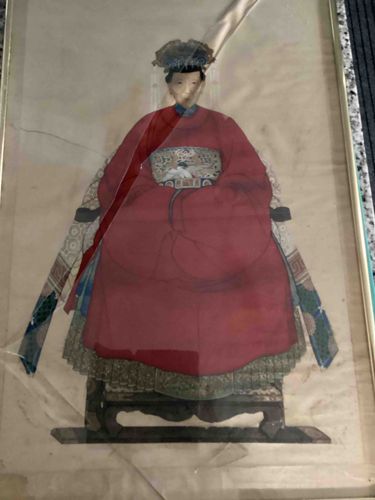
Chinese Ancestor Portrait of a Noblewoman

Asian Art & Antiques

AI Estimated Value

·Not an official valuation·Verify before acting

$600 - $900

As of June 1, 2026

AI Item Analysis

·AI can make mistakes·Verify before acting
This is a traditional Chinese ancestor portrait depicting an elderly noblewoman seated on a formal throne. The subject is dressed in a voluminous red robe featuring a detailed rank badge (buzi) on the chest, likely signifying civil or military rank. She wears a traditional ornate headdress and is positioned in a stiff, frontal pose characteristic of the Qing Dynasty style (though this may be an early 20th-century interpretation). The artwork utilizes fine mineral pigments on a paper or silk substrate, which has been mounted and framed. Notable physical characteristics include the layered garments with decorative borders and a footstool resting on a patterned rug. Regarding condition, the piece shows significant signs of age and distress; there is prominent horizontal and diagonal creasing across the entire surface, suggesting the substrate was once folded or crushed. There is visible water staining or foxing patterns in the lower right quadrant and general discoloration to the background. The frame appears to be a modern metallic replacement, which may not be archival. The craftsmanship exhibits typical stylized portraiture techniques used for lineage veneration, emphasizing social status over individual likeness. No visible maker's marks are discernible, which is standard for these commemorative works.
AI Appraisal Report

·AI can make mistakes·Verify before acting
I have performed a visual examination of this Chinese ancestor portrait. The piece follows the standard iconographic conventions of the Late Qing Dynasty style, depicting a noblewoman in a court robe and rank badge. Based on the pigments and the specific execution of the facial features, I estimate this to be a late 19th to early 20th-century work. The condition is a primary factor in this valuation; the substrate exhibits severe horizontal and diagonal creasing, consistent with poor storage or compression, along with visible foxing and water staining in the lower foreground. Such damage significantly limits the work's decorative appeal and collector value compared to pristine examples. The market for ancestor portraits is currently stable but selective, with high-quality 18th-century examples on silk fetching thousands, while later paper-based works in distressed condition typically sell in the upper hundreds. This piece's modern metallic frame further suggests it was remounted recently, potentially obscuring original margins. I must emphasize that a definitive determination of the substrate (silk vs. paper) and pigment composition is impossible via digital imagery. To verify authenticity and age beyond a reasonable doubt, an in-person inspection is required to assess the weave of the fabric or the fiber structure of the paper, as well as ultraviolet light analysis to detect modern retouching or synthetic dyes. Provenance documentation, such as collection history or purchase receipts from established Asian art dealers, would be necessary to elevate the valuation into the higher tiers of the market.

Get your items appraised

Instant estimates of your treasures with AI-powered appraisals

Browse More Appraisals