AI estimate as of November 8, 2025 · verify with a professional before acting
AI-Generated · Verify before acting
Everything on this page is generated by AI for informational purposes only. AI can make mistakes — the AI may misidentify items or misattribute them (artist, maker, brand, designer, origin, era). This is not an official valuation and should not be used for insurance, sale, tax, estate, legal, or lending purposes — or any decision requiring a certified appraisal. It is not an authoritative claim about any person, brand, or rights holder — do not share or rely on it as a factual statement about a third party. Always consult qualified professionals before making financial decisions.
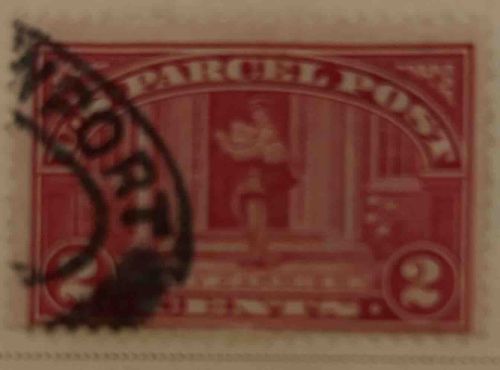
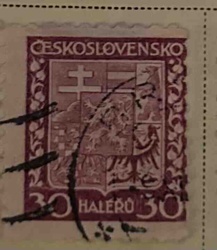
This is a United States Parcel Post stamp, specifically the 2-cent denomination, type 1, likely issued in 1913. The stamp is predominantly red or vermilion in color, featuring a rectangular shape with perforated edges, indicating it was intended for separation from a sheet. The central vignette depicts a detailed image of two male figures, possibly postmen or federal employees, handling mail or packages within what appears to be a government building or post office interior. Above this central scene, the words 'PARCEL POST' are clearly visible in an arching banner. In the lower right corner, the numeral '2' is enclosed in a circular design, signifying its 2-cent face value. The stamp has been postmarked with a dark, circular cancellation mark, partially obscuring the upper left and lower left portions of the stamp. The visible part of the cancellation includes letters 'PORT', suggesting a city or town name ending in this sequence, and portions of a date, though illegible. The paper appears to be of standard stamp quality for its era. The perforations are relatively clean but show minor signs of handling, typical for a used stamp. The overall condition, besides the cancellation, suggests an intact stamp with no visible tears or significant creasing. The colors are somewhat faded or muted in the image, but the design elements remain largely discernible despite the postmark.
AI Appraisal Report
I've examined the provided image of the United States Parcel Post 2 Cent (Type 1) stamp, likely from 1913. Based on the visual evidence, the stamp appears to be authentic. Its design, denomination, and 'PARCEL POST' inscription are consistent with known examples of this issue. The cancellation mark, while obscuring some details, seems typical of the period and does not raise immediate concerns about its legitimacy.
The condition, as observed from the image, is 'used' and appears to be in reasonably good shape for its age. There are no obvious tears or major creases; however, the colors seem somewhat muted, though this could be due to the image quality. The perforations appear relatively intact, but minor handling signs are present. The cancellation is fairly heavy, impacting the visual appeal.
Regarding market conditions, Parcel Post stamps are generally quite common, and the 2-cent denomination is no exception. This particular stamp, in used condition with a heavy partial cancellation, is not considered rare. Demand is moderate among general U.S. stamp collectors, but intense demand for common used examples is low.
Factors impacting this value include its common denomination, the heavily cancelled state, and the overall circulated appearance. For a definitive appraisal and authentication, a physical examination would be crucial. This would allow for a precise assessment of paper type, gum (if any remains, though unlikely for a used stamp), true color fidelity, precise perforation count, and any hidden flaws not visible in the image, such as thinning or repairs. Verification of the cancellation and its period-appropriateness would also benefit from in-hand inspection. Without physical inspection, I cannot comment definitively on factors like regumming, repairs, or subtle color variations that impact value.