AI estimate as of December 15, 2025 · verify with a professional before acting
AI-Generated · Verify before acting
Everything on this page is generated by AI for informational purposes only. AI can make mistakes — the AI may misidentify items or misattribute them (artist, maker, brand, designer, origin, era). This is not an official valuation and should not be used for insurance, sale, tax, estate, legal, or lending purposes — or any decision requiring a certified appraisal. It is not an authoritative claim about any person, brand, or rights holder — do not share or rely on it as a factual statement about a third party. Always consult qualified professionals before making financial decisions.
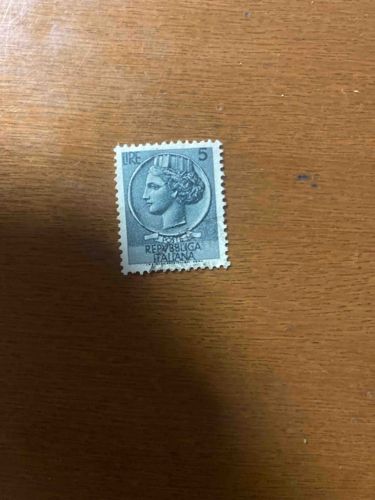
This item is a 5 Lire Italian postage stamp, part of the 'Democratica' series issued by the Repubblica Italiana (Republic of Italy). The stamp prominently features a classicized depiction of a female head in profile, facing left, encircled by a thin border. This allegorical figure is often interpreted as Italia Turrita, a national personification of Italy. She is shown wearing a mural crown, a common symbol for cities and nations in antiquity. The overall color of the stamp is a uniform, subdued grey-blue, indicating a monochrome printing process. The denomination '5' is visible in the upper right corner, with 'LIRE' (the currency unit) partially visible to its left, above the head. Below the circular design, the words 'REPUBBLICA ITALIANA' are printed in a sans-serif font. The stamp has perforated edges, which appear to be intact and evenly spaced, suggesting it was cleanly separated from a sheet. The paper appears to be of standard postage stamp quality for its era, possessing a matte finish. There are no significant visible condition issues such as tears, folds, or heavy creasing. The colors remain relatively consistent across the stamp, with no obvious signs of fading or discoloration. The printing quality is generally good, with crisp lines and details in the design. Based on the 'Democratica' series and the 'Repubblica Italiana' designation, this stamp dates to the post-World War II period, likely from the late 1940s or early 1950s, representing a significant period in Italy's transition to a republic. The precise year would require further philatelic identification. There are no discernible maker's marks or signatures on the face of the stamp, which is typical for common philatelic issues.
AI Appraisal Report
I have thoroughly examined the provided image of this 5 Lire 'Democratica' Italian postage stamp. Based on visual cues, the stamp appears authentic, consistent with known examples of the 'Repubblica Italiana' Democratica series from the late 1940s to early 1950s. The classicized depiction of Italia Turrita, the grey-blue monochrome printing, and the 'REPUBBLICA ITALIANA' inscription are all characteristic of this issue. The perforations seem clean and intact, suggesting a well-preserved, unmounted example. The printing quality is good, with crisp lines and no apparent fading or discoloration, indicating a 'fine-very fine' condition for a common stamp of this era. There are no visible tears, folds, or creasing, which further supports this condition assessment.
Market conditions for this particular stamp are generally modest. The 5 Lire 'Democratica' is a very common issue, printed in vast quantities during Italy's post-war recovery. While it holds historical significance, its high availability means demand rarely outstrips supply for individual unmounted examples. Rarity is low, and thus the value is primarily driven by its condition. A pristine, unmounted, unused example might fetch slightly more, but used examples or those with minor faults are typically valued at pennies.
Factors significantly impacting value for these common issues primarily relate to condition (e.g., centering, gum condition for unused stamps, clear cancellations for used stamps) and any specialized varieties (e.g., printing errors, watermarks, shade variations) which are not discernible from the provided image. For this specific stamp, the value is relatively low due to its commonality and the high number of surviving examples.
It is crucial to note that my authenticity verification is limited by assessing an image alone. A physical examination would allow me to verify the paper type, gum condition (if unused), precise shade, watermark (if present), and perforation accuracy. Scientific testing, such as expertization by a recognized philatelic association, would definitively confirm authenticity and rule out counterfeits or alterations, though such an expense would be unwarranted for a stamp of this low value.