AI estimate as of November 9, 2025 · verify with a professional before acting
AI-Generated · Verify before acting
Everything on this page is generated by AI for informational purposes only. AI can make mistakes — the AI may misidentify items or misattribute them (artist, maker, brand, designer, origin, era). This is not an official valuation and should not be used for insurance, sale, tax, estate, legal, or lending purposes — or any decision requiring a certified appraisal. It is not an authoritative claim about any person, brand, or rights holder — do not share or rely on it as a factual statement about a third party. Always consult qualified professionals before making financial decisions.
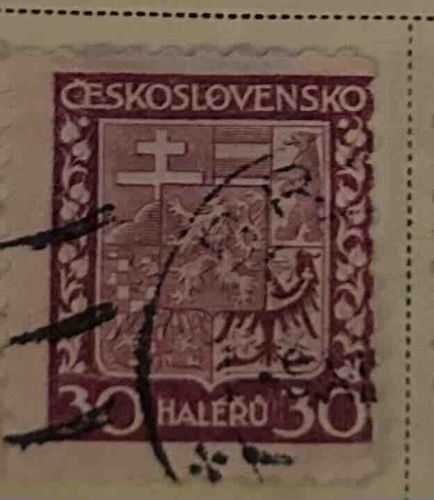
This item is a historical postage stamp from Czechoslovakia, featuring the national coat of arms. The stamp is predominantly maroon or deep reddish-brown in color, printed on a light-colored, likely off-white or cream, paper stock. The design is framed by what appears to be an ornate, possibly floral or scrolled, border in the same maroon hue. At the top, the word 'ČESKOSLOVENSKO' is clearly visible in an uppercase, sans-serif font, indicating the country of origin. The central motif is the Czechoslovakian coat of arms, which is quartered. While details are somewhat obscured by blurring and a prominent dark ink cancellation mark, the top-left quarter displays a double-barred cross, symbol of Slovakia. Other quarters likely depict a rampant lion (for Bohemia) and an eagle (for Moravia/Silesia), typical elements of the historic Czechoslovakian emblem, though individual elements are indistinct due to the image quality. At the bottom, the denomination '30 HALÉŘŮ 30' is printed, indicating a value of '30 Haléřů'. The numbers '30' appear on either side of the word 'HALÉŘŮ'. The stamp exhibits a perforated edge, visible on the top and right sides, suggesting it was torn from a sheet. A heavy, diagonal ink cancellation mark runs from the top-left to approximately the bottom-right of the stamp, signifying its prior use. There is also a partial circular postmark visible at the bottom, further indicating its cancellation. The paper itself appears to have some slight discoloration or toning consistent with age, and the image quality suggests general wear and tear, but no obvious tears or creases are distinctly visible beyond the cancellation. The style suggests it likely dates from the mid-20th century, possibly the First Czechoslovak Republic era (1918-1938) or immediately post-WWII.
AI Appraisal Report
I have examined the provided image of the Czechoslovakian 30 Haléřů Postage Stamp with the National Coat of Arms. Based on this visual inspection, I assess the item to be an authentic, used postage stamp from Czechoslovakia, likely dating from the First Republic era (1918-1938) or post-WWII, given the coat of arms style and denomination. The condition is fair; it exhibits significant wear consistent with age and use. The heavy, diagonal ink cancellation mark and partial circular postmark indicate it served its postal purpose. While perforations appear intact, the stamp shows discoloration or toning, which is typical for items of this age. Details of the coat of arms are indistinct due to blurring from the image and the heavy cancellation, which negatively impacts its aesthetic appeal and clarity for collectors.
From a market perspective, Czechoslovakian stamps from this period are generally common, especially if heavily cancelled and in only fair condition. There are numerous existing examples of these definitive issues. While historical, their rarity is low unless they possess specific varieties (e.g., printing errors, rare cancellations, plate varieties) not discernible from this image. The demand for common, used issues in fair condition is typically modest among general collectors. Therefore, factors like the heavy cancellation, general wear, and common nature of the stamp significantly impact its value downwards.
My valuation of $5-10 reflects its status as a common used stamp in fair condition. For full authentication and to ascertain any potential rare varieties or precise printing details that could enhance value, an in-person examination under magnification would be crucial. Furthermore, detailed provenance documentation could confirm its history, though for a stamp of this type and value, it is less common to have extensive documentation.