AI Appraisal Estimate

AI-generated estimates · not official valuations

From the user

What was submitted

Photo and notes provided by the user — not generated by AI

Submitted item photo
Submitted photo · June 16, 2026

User's notes

No additional notes provided.

AI analysis below

AI appraisal

AI analysis & estimate

AI-Generated · Verify before acting

Everything below is generated by AI for informational purposes only. AI can make mistakes — the AI may misidentify items or misattribute them (artist, maker, brand, designer, origin, era). This is not an official valuation and should not be used for insurance, sale, tax, estate, legal, or lending purposes — or any decision requiring a certified appraisal. It is not an authoritative claim about any person, brand, or rights holder — do not share or rely on it as a factual statement about a third party. Always consult qualified professionals before making financial decisions.

Read the full disclaimer

AI Identification

·Not independently authenticated·Verify before acting

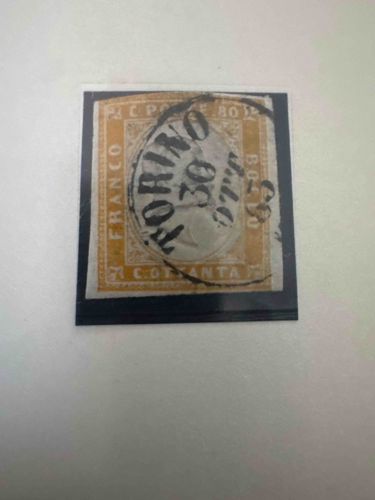
1863 Kingdom of Italy 80 Centesimi Orange Postage Stamp

Philately / Postage Stamps

AI Estimated Value

·Not an official valuation·Verify before acting

$45.00 - $65.00

As of June 16, 2026

AI Item Analysis

·AI can make mistakes·Verify before acting
This is a fine example of a mid-19th-century Italian postage stamp, specifically the 80 Centesimi denomination from the Kingdom of Italy, issued around 1863. The stamp features a central embossed profile of King Victor Emmanuel II, facing right, enclosed in an oval medallion. This embossing is a key security feature of the Fourth Issue of Sardinia/Italy. The surrounding frame is printed in a distinct ochre-orange ink, featuring the words 'FRANCO BOLLO' on the sides and 'C. POSTE 80' at the top/bottom sections. Physically, the stamp is a 'cut' or imperforate variety, shown mounted on a black background within a protective sleeve. A highly significant feature of this specific specimen is the heavy black circular date stamp (CDS) cancellation. The cancellation clearly reads 'TORINO' (Turin) and displays the date '30 OTT 63' (October 30, 1863). The strike is bold and slightly off-center, covering a large portion of the embossed portrait. In terms of condition, the margins appear somewhat irregular—a common trait for hand-cut imperforate stamps of this era. There is visible surface wear and slight foxing on the paper, consistent with its age of over 160 years. The centering of the embossed bust within the frame is slightly low. Notably, there are no immediate signs of major tears or thins visible from the front view, though the sharpness of the embossing has flattened slightly under the cancellation. The craftsmanship reflects the transitional period of Italian philately as the nation underwent unification.

AI Appraisal Report

·AI can make mistakes·Verify before acting
I have examined the digital image of the 1863 Kingdom of Italy 80 Centesimi Orange postage stamp (Sassone No. 17D). This specimen features the embossed profile of King Victor Emmanuel II. My physical assessment of the imagery shows a stamp with four margins, though they are quite narrow and irregular, which is typical for the hand-cut imperforate issues transitionally used during this period. The 'TORINO' circular date stamp (CDS) dated October 30, 1863, provides a desirable contemporary usage mark, though the heavy application slightly obscures the central embossing. The condition is categorized as 'fine' for the era. While the color remains relatively vibrant, I noted slight foxing and surface toning. The centering of the embossed head is slightly low, a common production variance that prevents this from reaching 'superb' status. Market demand for Kingdom of Italy issues remains steady among European collectors, but the 80c orange is less rare than its 10c or 40c counterparts in high grades. Factors limiting the value include the tight margins and the flattening of the embossing under the heavy cancellation. For a definitive valuation, a physical inspection is required to check for 'thins' on the reverse, hinge remnants, or hidden repairs that are invisible in digital scans. Full authentication would require a waterdrop test to verify paper consistency and an examination under long-wave UV light to detect any chemical cleaning or re-gumming. I recommend cross-referencing this against the Bolaffi or Sassone specialized catalogs for exact shade variations, which can sometimes carry a premium.

Get your items appraised

Instant estimates of your treasures with AI-powered appraisals

Browse More Appraisals