AI estimate as of September 7, 2025 · verify with a professional before acting
AI-Generated · Verify before acting
Everything on this page is generated by AI for informational purposes only. AI can make mistakes — the AI may misidentify items or misattribute them (artist, maker, brand, designer, origin, era). This is not an official valuation and should not be used for insurance, sale, tax, estate, legal, or lending purposes — or any decision requiring a certified appraisal. It is not an authoritative claim about any person, brand, or rights holder — do not share or rely on it as a factual statement about a third party. Always consult qualified professionals before making financial decisions.
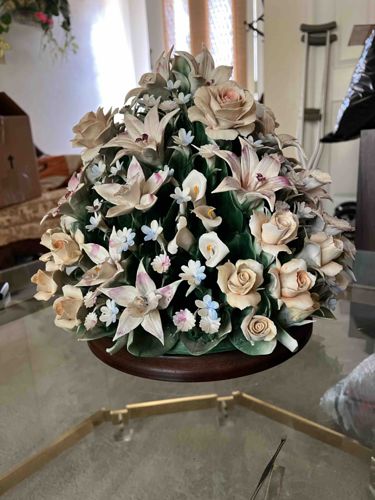
This item is a detailed porcelain floral arrangement, meticulously crafted to resemble a lush bouquet of various flowers, presented on a round, dark wood base. The primary flowers featured are light cream or off-white roses with subtle pink blush on their inner petals, delicate white lilies or orchids with purple or pinkish veins, and small white calla lilies. These larger blooms are interspersed with smaller filler flowers, including light blue and white forget-me-nots and other tiny white blossoms, providing visual depth and texture. The foliage consists of dark green leaves of varying sizes, forming the bulk of the underlying structure from which the flowers emerge.
The overall construction suggests individual porcelain pieces, likely hand-sculpted and painted, then assembled to create the unified arrangement. The material appears to be bisque or unglazed porcelain for a matte, lifelike finish, although some areas might have a subtle glaze for definition. The colors are predominantly muted and naturalistic, with soft pastels and earthy greens.
Observable condition issues appear minimal, with no obvious chips, cracks, or significant repair marks visible from the provided image. The dark wood base is smooth and polished, providing a stable foundation for the delicate porcelain. The quality of craftsmanship appears high, indicated by the intricate details of the petals, stamens, and leaves, suggesting a skilled artisan or manufacturer. Without maker's marks, it's challenging to determine the exact origin, but this style of intricate porcelain floral work was popular in the mid-to-late 20th century, particularly from Italian manufacturers like Capodimonte, though this is not confirmed without a visible mark. The piece has a somewhat delicate, almost ethereal quality, making it suitable as a decorative centerpiece for a table or mantel.
AI Appraisal Report
Upon visual examination of the Porcelain Floral Arrangement Centerpiece on Wood Base, I observe a meticulously crafted item. The porcelain appears to be bisque or unglazed, which contributes to its lifelike appearance. The intricate details of the various flowers—roses, lilies, orchids, calla lilies, and filler blooms—along with the varying shades of green foliage, indicate a high level of artisanal skill. The color palette is naturalistic and soft, enhancing its delicate aesthetic. I see no obvious chips, cracks, or repairs, suggesting excellent condition for its type. The dark wood base is a fitting and stable foundation.
Authenticity, based solely on images, is challenging. While the style strongly resembles Italian porcelain manufacturers, particularly in the Capodimonte tradition prevalent mid-to-late 20th century, the absence of maker's marks or signatures prevents definitive attribution. Without such marks, establishing a specific manufacturer or provenance is impossible. This limits the high-end value associated with renowned makers.
Regarding market conditions, porcelain floral arrangements generally have a steady, albeit niche, demand among decorative arts collectors. Pieces in excellent condition, especially those demonstrating superior craftsmanship like this one, command better prices. Comparables without clear maker's marks typically fall into a mid-range value category. Factors impacting value include the exceptional condition and intricate detail. However, the lack of verifiable origin is the primary limiting factor for a higher appraisal.
To fully authenticate and confirm origin, an in-person examination would be critical to search for any subtle impressed or painted marks, assess the porcelain quality and firing process firsthand, and potentially perform scientific testing if specific manufacturing techniques were suspected. Provenance documentation (purchase receipts, historical records) would also significantly enhance its value by confirming its history and maker.