These notes were written by the person who submitted this item. Appraiser.AI has not verified them, and the AI's identification and estimate may rely on them.
AI Estimated Value
Not an official valuation
$150-$250
AI estimate as of July 26, 2025 · verify with a professional before acting
AI-Generated · Verify before acting
Everything on this page is generated by AI for informational purposes only. AI can make mistakes — the AI may misidentify items or misattribute them (artist, maker, brand, designer, origin, era). This is not an official valuation and should not be used for insurance, sale, tax, estate, legal, or lending purposes — or any decision requiring a certified appraisal. It is not an authoritative claim about any person, brand, or rights holder — do not share or rely on it as a factual statement about a third party. Always consult qualified professionals before making financial decisions.
This analysis also relies on unverified notes provided by the user, which may be incomplete or inaccurate and could affect the result.
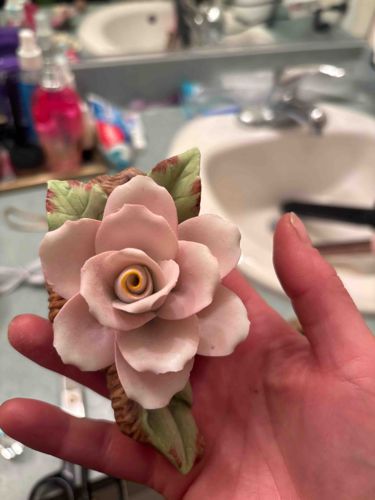
This item is a finely crafted porcelain floral sculpture, specifically depicting a blooming light pink rose with accompanying foliage. The rose itself features numerous delicate petals, layered to create a realistic, open blossom effect. The outermost petals exhibit a slightly lighter, almost white hue at their edges, gradually deepening to a soft, blush pink towards the center. The very core of the rose, the stamen, is rendered in a vibrant yellow, spiraling outwards. Attached to the base of the rose are several green leaves, showing subtle variations in color, including hints of reddish-brown along their veins, contributing to a naturalistic appearance. The textured stem or branch element below the flower and leaves is rendered in a naturalistic brown. The overall construction implies it might be a decorative accent, possibly a brooch, a wall hanging, or part of a larger mounted arrangement, given its flat reverse side implied by being held in a palm. The porcelain appears to be of high quality, exhibiting a smooth, lustrous glaze that enhances the delicate details of the petals and leaves. There are no immediately visible chips, cracks, or significant wear, suggesting it is in good to excellent condition, although a closer inspection for minor abrasions or factory imperfections would be necessary for a definitive assessment. The craftsmanship suggests a mid-20th century to contemporary manufacturing period, typical of studios specializing in detailed porcelain work, such as Capodimonte or similar European manufacturers renowned for their realistic floral pieces. The attention to detail in the veining of the leaves and the delicate curling of the petals indicates skilled artistry.
AI Appraisal Report
Based on my visual examination of the provided image and description, this porcelain floral sculpture of a pink rose is a finely executed decorative art piece. The condition appears to be excellent, with no visible chips, cracks, or significant wear. The smooth, lustrous glaze and delicate detailing of the petals and leaves suggest high-quality craftsmanship, typical of European porcelain studios specializing in realistic florals, such as Capodimonte or similar manufacturers from the mid-20th century to contemporary periods. The naturalistic color variations in the rose, the yellow stamen, and the green leaves with reddish-brown veins all contribute to its appeal.
Market conditions for detailed porcelain florals remain steady, particularly for well-executed pieces in excellent condition. Demand is driven by collectors of decorative arts and individuals seeking elegant home decor. While not exceptionally rare, pieces of this quality maintain a consistent market presence. Factors positively impacting its value include the superb craftsmanship, excellent condition, and timeless aesthetic.
It is important to note the limitations of an appraisal based solely on images. While the visual indicators are strong, a definitive authenticity verification (e.g., confirming it is indeed Capodimonte or similar high-end manufacturer) would require an in-person examination to search for maker's marks, conduct tactile assessment of the porcelain body, and potentially perform scientific testing if provenance is unclear. Without physical inspection, I cannot confirm the exact manufacturer or rule out subtle repairs or factory imperfections. Provenance documentation, such as original purchase receipts or certificates, would also significantly aid in authentication and value assessment.