AI estimate as of October 23, 2025 · verify with a professional before acting
AI-Generated · Verify before acting
Everything on this page is generated by AI for informational purposes only. AI can make mistakes — the AI may misidentify items or misattribute them (artist, maker, brand, designer, origin, era). This is not an official valuation and should not be used for insurance, sale, tax, estate, legal, or lending purposes — or any decision requiring a certified appraisal. It is not an authoritative claim about any person, brand, or rights holder — do not share or rely on it as a factual statement about a third party. Always consult qualified professionals before making financial decisions.
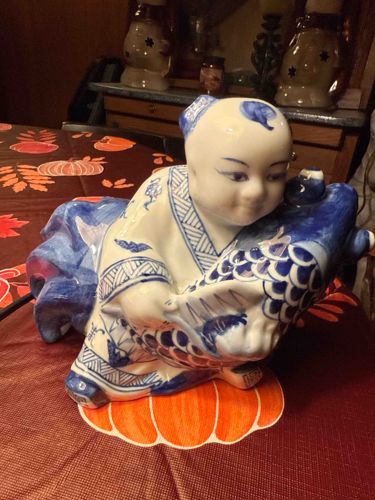
This item is a ceramic sculpture depicting a young child, likely a boy, intimately embracing or riding a large koi fish. The piece is rendered in classic blue and white porcelain, typical of Chinese decorative arts. The child's skin is a smooth, unadorned white glaze, while his clothing, hair, and the koi fish feature intricate blue patterns against a white background. The child wears a traditional robe or tunic adorned with geometric borders on the sleeves and collar, and what appear to be stylized bat or cloud motifs on the main body of the garment. His hair is styled with a topknot, also decorated in blue. The facial features are delicately painted with fine blue lines for the eyebrows, eyes, and mouth, conveying a serene and somewhat playful expression. The koi fish is predominantly blue with scales detailed in a darker, more intense blue, and sections of lighter blue for its fins and tail. The overall craftsmanship suggests a high level of skill in porcelain molding and hand-painting. The sculpture rests on what appears to be a separate, but integrated, base molded to represent a stylized lotus pad or cushion, which is painted in a vibrant orange hue. There are no immediately obvious condition issues like chips or cracks visible in the provided image. The glossy finish of the glaze indicates well-preserved condition. The style is indicative of traditional Chinese porcelain figures, possibly late 19th to mid-20th century, though dating without maker's marks or more context is challenging. The combination of the child and koi often symbolizes prosperity, abundance, and good fortune in East Asian cultures. The scale of the item is difficult to determine precisely without reference, but it appears to be a substantial decorative piece, likely a tabletop or mantel ornament. The quality of the hand-painted details and the smooth, consistent glaze are strong indicators of its craftsmanship.
AI Appraisal Report
I've examined the provided image of this Blue and White Porcelain Child with Koi Sculpture. The piece appears to be in excellent condition; the glossy finish, smooth white glaze, and vibrant blue patterns show no visible chips, cracks, or significant wear. The intricate hand-painted details on the child's clothing, hair, and the koi's scales suggest a high level of craftsmanship, indicating quality production. The serene expression on the child's face and the dynamic depiction of the koi contribute to its aesthetic appeal.
Authenticity of age is challenging to determine solely from an image. While the style is consistent with traditional Chinese decorative arts, possibly late 19th to mid-20th century, confirming this without physical inspection is impossible. Factors like the crispness of the underglaze-blue work and the type of porcelain body would need in-person examination. Marks on the base, if any, would be crucial for precise dating and attribution. Without provenance documentation or scientific testing to verify the age, I must appraise it as a decorative piece in the traditional style.
In terms of market conditions, blue and white porcelain figures, particularly those combining auspicious motifs like a child and koi (symbolizing prosperity and good fortune), generally maintain a stable demand among collectors of Asian decorative arts. While not exceptionally rare, well-executed pieces like this are sought after. Comparables for similar-sized, quality reproductions or period decorative pieces often fall within the $600-900 range. The value is significantly impacted by its excellent condition and detailed artistry. If it were definitively authenticated as an earlier, significant period piece, its value could be substantially higher. For full authentication, I'd need to physically inspect the porcelain body, glaze, and any maker's marks, and ideally, have provenance documentation.