AI estimate as of July 4, 2025 · verify with a professional before acting
AI-Generated · Verify before acting
Everything on this page is generated by AI for informational purposes only. AI can make mistakes — the AI may misidentify items or misattribute them (artist, maker, brand, designer, origin, era). This is not an official valuation and should not be used for insurance, sale, tax, estate, legal, or lending purposes — or any decision requiring a certified appraisal. It is not an authoritative claim about any person, brand, or rights holder — do not share or rely on it as a factual statement about a third party. Always consult qualified professionals before making financial decisions.
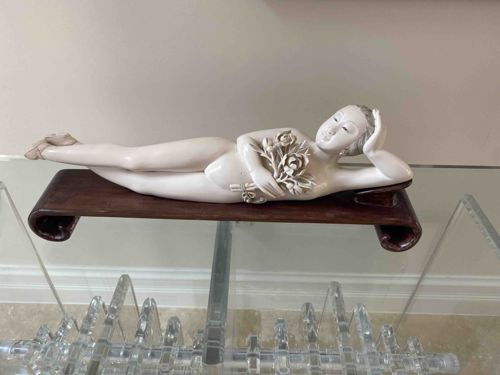
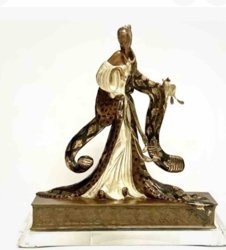
This item is an intricately carved, reclining female figurine, often referred to as a "Doctor's Lady" or "Medical Lady" figurine, typically used in historical Chinese medicinal practices. The figurine is crafted from a material that appears to be ivory, or a very realistic ivory-like resin or bone substitute, given its smooth, creamy white color and naturalistic sheen. It depicts a nude woman gracefully reclined on her left side, propped up on her left elbow with her head resting gently in her hand, suggesting a pose of leisure or contemplation. Her right arm is bent, holding a cluster of what appear to be carved floral elements, possibly roses or peonies, covering her torso. The detail in her face is subtle but refined, with delicate features, closed or downcast eyes, and a serene expression. Her hair is styled in a traditional bun or chignon. Her body shows naturalistic contours and proportions, with sculpted fingers and toes. The figurine rests on a separate, dark wood base, possibly carved from a type of rosewood or mahogany, given its deep reddish-brown color and polished finish. The base is simple yet elegant, with curved, scroll-like ends, providing a stable and aesthetic support for the sculpture. There are no overt signs of damage, chips, or repairs visible from the provided images, suggesting it is in good to excellent condition. The surface appears smooth and well-preserved, with a subtle patina consistent with age if it is indeed antique ivory. The craftsmanship is high quality, indicating skilled artistry, particularly in the delicate carving of the hands, face, and floral elements. The style suggests an East Asian origin, likely Chinese, and these types of figurines often date from the Qing Dynasty or early 20th century, though without hallmarks or specific provenance, a precise age is difficult to ascertain from images alone.
AI Appraisal Report
Based on my visual examination of the Chinese Reclining Doctor's Lady Figurine with Wooden Base, the piece appears to be in good to excellent condition with no visible damage, chips, or repairs. The creamy white color and naturalistic sheen of the figurine are consistent with aged ivory, or a very well-executed ivory-simulant. The detailed carving, particularly of the hands, face, and floral elements, indicates high-quality artistry. The dark, polished wooden base complements the figurine well and appears sturdy.
Determining authenticity, especially regarding the material, is challenging without an in-person examination. While it strongly resembles ivory, it could be a sophisticated resin or bone substitute. True ivory would exhibit specific grain patterns (Schreger lines) and a unique tactile feel that cannot be assessed through images. For definitive authentication of the material and age, a physical inspection is crucial, potentially involving microscopy or scientific dating techniques. Provenance documentation, such as purchase receipts or historical records, would also provide significant validation.
These 'Doctor's Lady' figurines, originating from historical Chinese medicinal practices, have a steady demand among collectors of Asian arts and medical antiques. If confirmed as genuine antique ivory from the Qing Dynasty or early 20th century, its rarity and historical significance would be considerably higher. The market for antique ivory is subject to strict regulations and ethical considerations, which can influence resale value, even for legally acquired pieces. However, given its apparent quality and condition, this piece holds value even as a well-made ivory-simulant.
Without physical authentication of the material and age, the primary factor impacting value is this uncertainty. If it is genuine antique ivory, the value would be significantly higher. If it is a modern resin or bone reproduction, the value would be much lower. My appraisal range reflects this critical variable.