AI estimate as of July 25, 2025 · verify with a professional before acting
AI-Generated · Verify before acting
Everything on this page is generated by AI for informational purposes only. AI can make mistakes — the AI may misidentify items or misattribute them (artist, maker, brand, designer, origin, era). This is not an official valuation and should not be used for insurance, sale, tax, estate, legal, or lending purposes — or any decision requiring a certified appraisal. It is not an authoritative claim about any person, brand, or rights holder — do not share or rely on it as a factual statement about a third party. Always consult qualified professionals before making financial decisions.
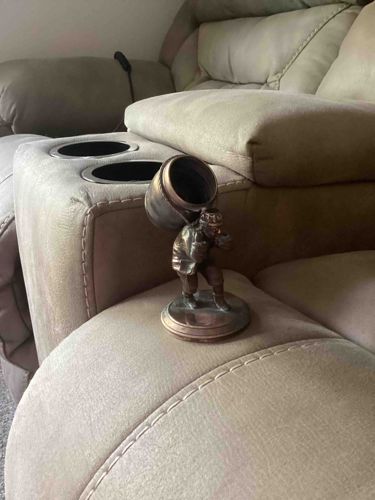
The item is a small, figural sculpture depicting a man carrying a large, stylized vessel or barrel. It appears to be made from a metal alloy, likely spelter or a similar base metal, given its casting detail and the appearance of the finish. The color is a uniform bronze tone, suggesting either a patinated finish or a bronze-colored coating. The figure itself is rendered in a somewhat stylized, possibly almost cartoonish or folk-art manner, as opposed to a strictly realistic academic style. The man is depicted in a squatting or bending posture, with strong musculature implied, struggling under the weight of the large object he carries on his back. The vessel he carries is cylindrical with a slightly flared top opening, suggesting it is designed to hold something. The interior of this vessel appears dark, possibly from use or a darker finish. The entire sculpture is mounted on a round, stepped base, which adds stability and a finished look to the piece. The surface shows some signs of wear, particularly on raised areas, indicating a slight loss of the bronze finish or a rubbing of the patina, revealing a lighter metallic hue beneath. This wear is consistent with handling and age. There are no immediately discernible maker's marks or signatures visible in the provided image. The style suggests it could be from the early to mid-20th century, possibly as a novelty item, smoking accessory (like an ashtray or match holder), or simply a decorative desk ornament. The craftsmanship appears to be a good quality casting with reasonable detail for its size and likely material.
AI Appraisal Report
Upon examining the provided image of the Figural Man Carrying Barrel Sculpture with Holder, I can assess its condition as good, consistent with age and typical handling. The uniform bronze-toned finish shows minor wear, particularly on raised surfaces, revealing a lighter metallic hue. This suggests either a patinated spelter or a bronze-coated base metal. There appear to be no major losses, cracks, or repairs.
Authenticity, based solely on this visual, points to a period piece from the early to mid-20th century. The stylized folk-art manner and casting quality align with many decorative metalware items produced during that era, often serving as novelty items, desk accessories, or smoking accoutrements. Without physical examination, I cannot definitively determine the exact metal composition or rule out modern reproductions attempting to mimic the aged patina. Key factors impacting value include the material (spelter being less valuable than true bronze), the specific manufacturer if identifiable, and its original purpose, if it had one beyond decorative.
Market conditions for such decorative figural sculptures are moderate. While unique and charming, these items generally appeal to niche collectors rather than a broad market. Comparables for similar spelter or pot-metal figural pieces of this size and period typically fluctuate, with items functioning as an ashtray or match holder often having a slightly higher appeal. Demand is steady but not high, and the rarity is low to moderate; while this specific design may be uncommon, similar figural pieces were mass-produced.
For full authentication, an in-person examination would be crucial to physically assess the metal, check for hidden marks, and evaluate weight and feel. Scientific testing, like X-ray fluorescence (XRF), could confirm material composition. Provenance documentation, such as original sales receipts or family history, would also add significant verifiable authenticity. Currently, it presents as an authentic period piece, likely made of spelter.