AI estimate as of November 3, 2025 · verify with a professional before acting
AI-Generated · Verify before acting
Everything on this page is generated by AI for informational purposes only. AI can make mistakes — the AI may misidentify items or misattribute them (artist, maker, brand, designer, origin, era). This is not an official valuation and should not be used for insurance, sale, tax, estate, legal, or lending purposes — or any decision requiring a certified appraisal. It is not an authoritative claim about any person, brand, or rights holder — do not share or rely on it as a factual statement about a third party. Always consult qualified professionals before making financial decisions.
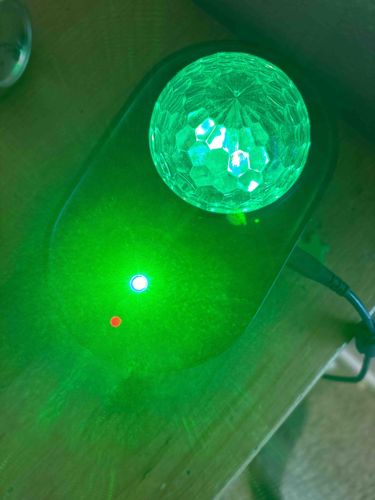
This item is a compact, portable disco ball light projector, designed for personal entertainment or small gatherings. Its physical characteristics include a rounded, possibly ovoid or bean-shaped, dark-colored base, likely made of plastic, which appears to be glossy black or a very dark gray. Protruding from one end of the base is a translucent, faceted sphere, which serves as the primary light projection element. This sphere is emitting a vibrant green light, suggesting it contains LEDs (Light Emitting Diodes) that produce various colors, though only green is visible in this image. The facets on the sphere are designed to refract and scatter the light, creating a classic disco-ball effect with multiple moving light spots. The sphere itself appears to be approximately 1.5 to 2 inches in diameter. On the base, near the sphere, two small indicator lights are visible: one glowing white/pale blue and another glowing red. These likely indicate power status, charging status, or operational modes. A dark USB cable is partially visible entering the base on the right side, confirming its power source and suggesting it's a 'plug-and-play' device. The overall construction appears to be machine-manufactured with molded plastic components, typical of modern consumer electronics. There are no visible signs of wear, damage, or repairs in the provided image; the item appears to be in good, functional condition. The style is contemporary, typical of novelty lighting devices prevalent in the last decade. Its small size and USB power imply portability and ease of use with various devices like laptops, power banks, or car chargers. The craftsmanship appears mass-produced but functional, with a focus on delivering a specific visual effect.
AI Appraisal Report
Upon visual examination of the provided image, I assess this Mini USB Disco Ball Light Projector to be in excellent, seemingly new, condition. There are no visible blemishes, scratches, or operational defects suggesting prior use or damage. Authenticity, in the sense of it being a genuine product from a specific manufacturer, is difficult to ascertain from an image alone given the vast number of generic manufacturers producing similar items. It appears to be an authentic example of a mass-produced novelty item.
Market conditions for such novelty lighting devices are characterized by high volume and low price points. Comparable items are widely available on e-commerce platforms like Amazon, eBay, and various electronics retailers for prices typically ranging from $5 to $20. Demand for these items is steady, driven by their affordability and ability to add a fun ambiance. However, they are not rare; quite the opposite, they are ubiquitous. Factors impacting value significantly include its 'new in box' condition if presented, but even then, the inherent value remains low due to mass production and lack of intellectual property premiums.
Limitations in authenticity verification are substantial. Without physical inspection, I cannot confirm brand markings, internal components, material quality, or operational functionality. I cannot verify if it's a genuine product from a known brand (if any specific brand is claimed) versus a generic copy. An in-person examination would allow for inspection of branding (if any), material quality, and functional testing. Provenance documentation (e.g., original purchase receipts) or scientific testing (e.g., component analysis) would be entirely disproportionate for an item of this commodity value but would be necessary for full authentication if it were a high-value collectible item, which it is not.