These notes were written by the person who submitted this item. Appraiser.AI has not verified them, and the AI's identification and estimate may rely on them.
AI Estimated Value
Not an official valuation
$75 - $125
AI estimate as of July 25, 2025 · verify with a professional before acting
AI-Generated · Verify before acting
Everything on this page is generated by AI for informational purposes only. AI can make mistakes — the AI may misidentify items or misattribute them (artist, maker, brand, designer, origin, era). This is not an official valuation and should not be used for insurance, sale, tax, estate, legal, or lending purposes — or any decision requiring a certified appraisal. It is not an authoritative claim about any person, brand, or rights holder — do not share or rely on it as a factual statement about a third party. Always consult qualified professionals before making financial decisions.
This analysis also relies on unverified notes provided by the user, which may be incomplete or inaccurate and could affect the result.
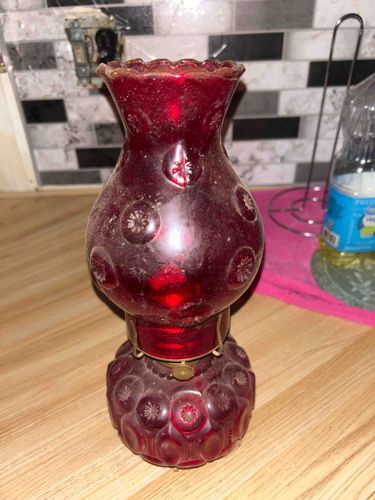
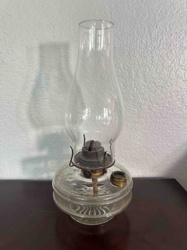
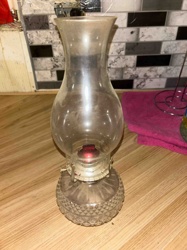
This is a vintage or antique glass oil lamp, likely made of ruby red pressed glass. The lamp features a two-part construction: a glass font (the lower, wider section meant to hold the oil) and a glass chimney/shade (the upper, narrower section designed to protect the flame and direct light). The overall height appears to be approximately 10-14 inches, judging by its apparent scale relative to the background items.
The glass is a deep, translucent ruby red color, which is characteristic of popular glass patterns from the late 19th to early 20th century. Both the font and the upper chimney/shade section are adorned with a repeating pattern of raised, circular medallions, each containing a star or floral-like burst design. This 'thumbprint' or 'bullseye' type pattern, often with an internal star, was common in pressed glass. The top edge of the chimney/shade has a scalloped or ruffled rim, adding to its decorative appeal.
Connecting the glass font to the upper glass piece is a brass or bronze metal collar, which would typically house the wick mechanism (burner). This collar appears to be somewhat tarnished or show signs of age-appropriate patina, suggesting it is original to the lamp. A small, knurled knob, likely for adjusting the wick, is visible on the side of this collar.
The lamp shows clear signs of age and condition issues common with vintage items. It is heavily covered in a layer of dust and dirt, indicating it has been stored or displayed in a neglected environment. There are no immediate visible cracks or chips, but a thorough cleaning would be necessary to ascertain true structural integrity and finish quality. The presence of dust suggests the glass might also have a dullness or film, which cleaning could remove. The metal components show patination consistent with age. Without maker's marks or further provenance, precise manufacturing details or the specific glass pattern name are difficult to determine, but its characteristics point to a common pressed glass style from the Victorian or early 20th-century era, likely American-made.
AI Appraisal Report
Upon my virtual examination of this Ruby Red Pressed Glass Oil Lamp, I can confirm its vintage or antique status, consistent with late 19th to early 20th-century American pressed glass. The two-part construction, characteristic ruby red color, and 'thumbprint' or 'bullseye' pattern with star motif are all typical of the era. The scalloped rim on the chimney/shade adds a desirable decorative element. The brass or bronze collar with a visible wick adjustment knob appears original and shows age-appropriate patination, which is a positive sign for authenticity.
However, the lamp's condition significantly impacts its immediate value. It is heavily covered in dust and dirt, obscuring the true luster of the glass and making a definitive assessment of its finish and structural integrity challenging. While no immediate cracks or chips are apparent from the image, a thorough in-person cleaning is essential to detect any hidden flaws such as sickness, internal cracks, or minor chips that would reduce value. The tarnished metal also needs proper cleaning to ascertain its underlying condition.
Market conditions for common pressed glass oil lamps are steady but not high unless they are from highly sought-after patterns or manufacturers. Demand for ruby red is generally good due to its aesthetic appeal. Rarity is moderate, as many similar lamps were produced. The lack of visible maker's marks is a detractor, as a identified pattern by a reputable maker (e.g., Fenton, Hobbs, Atterbury) would fetch a higher price.
Factors significantly impacting value are its current dirty state, which suggests neglect, and the inability to confirm structural soundness and the absence of glass sickness without physical handling. Provenance documentation, while not provided, would be beneficial.
Limitations: My assessment of condition and authenticity is based solely on the provided image and description. A physical examination is crucial to confirm the absence of chips, cracks, stress fractures, or 'sick glass' (etching/cloudiness from prolonged exposure to water or poor cleaning). Only with a direct inspection can I ascertain the true brilliance of the glass, the functionality of the burner mechanism, and the full extent of any potential damage or wear. Scientific testing is not typically required for this type of item, but an in-hand inspection for manufacturer marks is vital for precise identification and corresponding valuation.